

Zambia signs US$2.49bn US health pact after holding firm on data and minerals

Breaking News Zambia
Local NewsZambia signs US$2.49bn US health pact after holding firm on data and minerals Zambia and the United States yesterday signed a five-year health agreement worth about US$2.49 billion in Lusaka. The deal ends months of hard bargaining in which Zambian negotiators struck out a…
Zambia signs US$2.49bn US health pact after holding firm on data and minerals
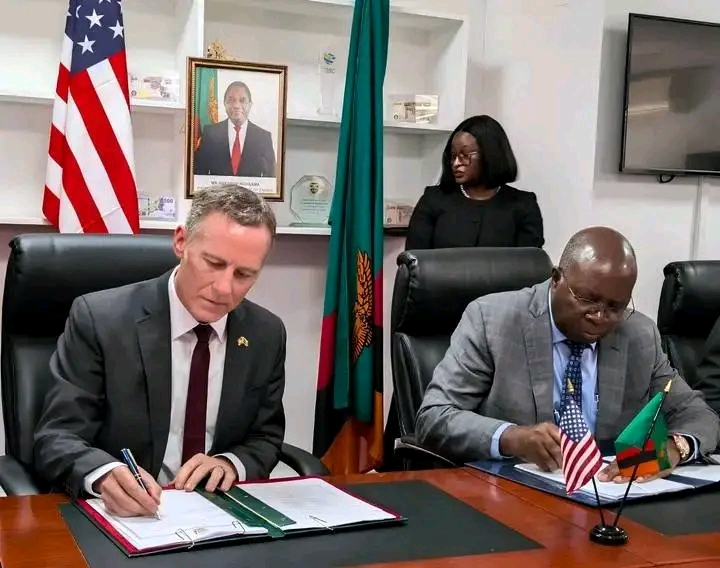
Zambia and the United States yesterday signed a five-year health agreement worth about US$2.49 billion in Lusaka. The deal ends months of hard bargaining in which Zambian negotiators struck out a specimen-sharing clause, narrowed Washington’s demands for health data and kept the country’s copper and cobalt out of the deal. The memorandum of understanding will finance the recruitment of 40,000 health workers and secure an uninterrupted supply of HIV, tuberculosis and malaria medicines.
The United States will commit more than US$1.5 billion over the five years to priority health programmes. Zambia has pledged an extra US$975 million of its own money to the sector over the same period. The arrangement is therefore a co-investment, a clear break from the donor-and-recipient model that shaped American health support in Zambia for two decades.
The signing comes five months after the talks very nearly collapsed. In May, Foreign Affairs and International Cooperation Minister Mulambo Haimbe halted negotiations. He described the American demand for sensitive health data as unconscionable and rejected any attempt to tie health support to a separate agreement on critical minerals.
Mr Haimbe returned to the table with a very different message. Speaking at the ceremony, he said Zambia had successfully “decoupled” critical minerals from the health agreement. That matter, he explained, is being handled in separate talks with the United States and has no place in the signed document.
The minister said the negotiations had removed several conditions and clauses that Lusaka found unacceptable. He added that the final text was shaped through wide consultation across Government.
“I am also pleased to note that the development of this Memorandum of Understanding has been undertaken through an extensive consultative process involving Government institutions,” Mr Haimbe said.
A workforce dividend
For Health Minister Roma Chilengi, the headline is the people the money will put on hospital wards and in villages. He called the agreement a monumental and landmark decision for Zambia’s health system, and set out how the 40,000 jobs would be shared.
“Forty thousand healthcare workers will be employed, 15,000 being front-liners like nurses, medical doctors, midwives, pharmacists, clinical officers and laboratory scientists. While 25,000 will be community health workers,” Professor Chilengi said.
He said the partnership would also protect the country’s medicines supply chain, particularly for drugs used against malaria, HIV and tuberculosis. Disease surveillance will be strengthened and electronic health systems expanded.
The funded programmes cover HIV and AIDS, tuberculosis, malaria, maternal and child health, disease surveillance, and preparedness for infectious disease outbreaks. Together they make up the backbone of public health in a country where a single missed delivery of antiretrovirals can be felt in every district clinic.
The data fight, settled
The negotiations turned largely on information. Earlier drafts would have required Zambia to share health data for a period far longer than the five years of funding, along with requirements touching on personally identifiable information. Professor Chilengi said those provisions had been reviewed in the final agreement.
Zambia’s Ambassador to the United States, Chibamba Kanyama, went further. He said the requirement to share biological specimens had been removed entirely, and that data sharing was now restricted to monitoring and evaluating the programmes being funded.
Dr Kanyama said the public objections raised at home had shaped Zambia’s position at the table.
“In a true partnership, we cannot simply brush aside these public anxieties. They represent our cultural values, our sovereignty, and our right to protect our people’s data and resources,” he said.
Washington’s view
United States Embassy chargé d’affaires Mich Coker said American support to Zambia’s health sector since 2004 had exceeded US$5 billion, and that the new framework was designed to protect and build on those gains through Zambian institutions.
“This $2.49 billion MoU tells a powerful story of mutual commitment. Over the next five years, the United States, working with Congress, plans to provide more than $1.5 billion in Zambia’s priority health programmes,” Mr Coker said.
He said the agreement marked a shift towards a partnership based on Zambian leadership, ownership and shared accountability. The text, he added, carries clear protocols to protect personal health information, because data privacy is essential to keeping public trust. He repeated that critical minerals were not part of the deal.
Relief for the Treasury
Finance and National Planning Minister Situmbeko Musokotwane framed the agreement in fiscal terms. He said American support would ease the burden on a Government that would otherwise have to carry the full weight of the country’s health spending.
“The agreement that we have just signed provides relief in the sense that if we are to be 100 per cent responsible for our health expenditure, then life can be much harder,” Dr Musokotwane said.
World Bank data show that health spending reached 5.98 percent of gross domestic product in 2023, up from 5.21 percent the year before. That rising bill is the backdrop to the minister’s remarks.
A harder bargain than most
The agreement falls under the America First Global Health Strategy, which Washington launched in September 2025. It replaced traditional grants through USAID and the President’s Emergency Plan for AIDS Relief with five-year bilateral compacts.
Several African governments have struggled with the terms. Kenya’s agreement was stopped by its High Court amid challenges over patient data and pathogen information. Zimbabwe walked away from a deal worth about US$350 million, and Ghana turned down the American conditions over data sharing.
Zambia chose a third path: it stayed at the table, refused the clauses it could not accept and signed only once they had been rewritten. That outcome gives the Government a ready answer to those who warned that health aid would be traded for mineral concessions.
The recruitment drive and the Treasury’s US$975 million pledge now move from paper to practice over the next five years. The talks on critical minerals continue on their own, separate track.

Community Feedback