
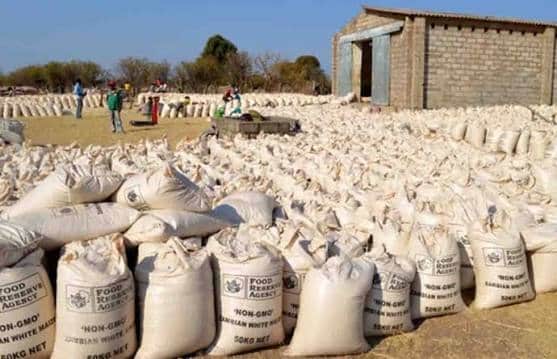
As FRA withdraws from crop marketing, will farmers adapt or lose out?

Breaking News Zambia
NewsThe National Association of Smallholder Farmers (NASFA) […]
The National Association of Smallholder Farmers (NASFA) has called on Zambian farmers to organize themselves into groups and determine maize prices based on their production costs, rather than waiting for buyers to dictate market prices.
This advice follows the government’s recent announcement that the Food Reserve Agency (FRA) will not fully participate in crop marketing during the upcoming season, clarifying that FRA’s mandate is to manage the country’s strategic food reserve, not to act as a crop marketing agency.
Instead, a new private-sector-driven entity will be established for crop marketing.
Speaking in an interview with Zambian Business Times (ZBT), NASFA Executive Director, Dr. Frank Kayula said the change can create challenges for smallholder farmers who have largely depended on FRA as a reliable market for their maize.
Dr Kayula added that the reported 5.1 million metric tonnes of maize produced this year has provided farmers with an opportunity to earn income, although small-scale farmers remain limited by low productivity and the small quantities they produced.
“The major benefit is that farmers who participated in producing the 5.1 million metric tonnes are able to sell their maize and make money, but smallholder farmers could earn more if they increased their production,” he said.
Dr. Kayula said the planned reduction in FRA’s crop-marketing role can become a major concern as government targets 10 million metric tonnes of maize production, particularly if farmers are not prepared to negotiate with private buyers.
“The challenge farmers have is access to markets, because many have relied on FRA as the market that gives them a reasonably good price, so we need to prepare them to participate in the open market,” he said.
Dr Kayula explained that farmers need education and awareness about production costs and collective marketing to avoid being disadvantaged when negotiating with private-sector buyers. “Do not wait for the buyer to fix the price, because the buyer will always fix you as a supplier, so farmers must understand their costs and know what price they need for their produce,” he said.
The NASFA Executive Director warned that farmers selling individually can struggle to negotiate better prices, while collective action can give them a stronger voice and help them resist pressure to accept unfavourable offers.
Dr Kayula said some buyers can take advantage of farmers’ lack of coordination, making it important for farmers to work together, agree on prices and honour their collective decisions when selling their maize.
He added that NASFA hopes that the Ministry of Finance will provide financing to help prepare smallholder farmers for the transition to private-sector crop marketing, warning that without adequate support, farmers risk losing out despite the country’s bumper harvest.
Article by Philip Sinkala





Community Feedback