
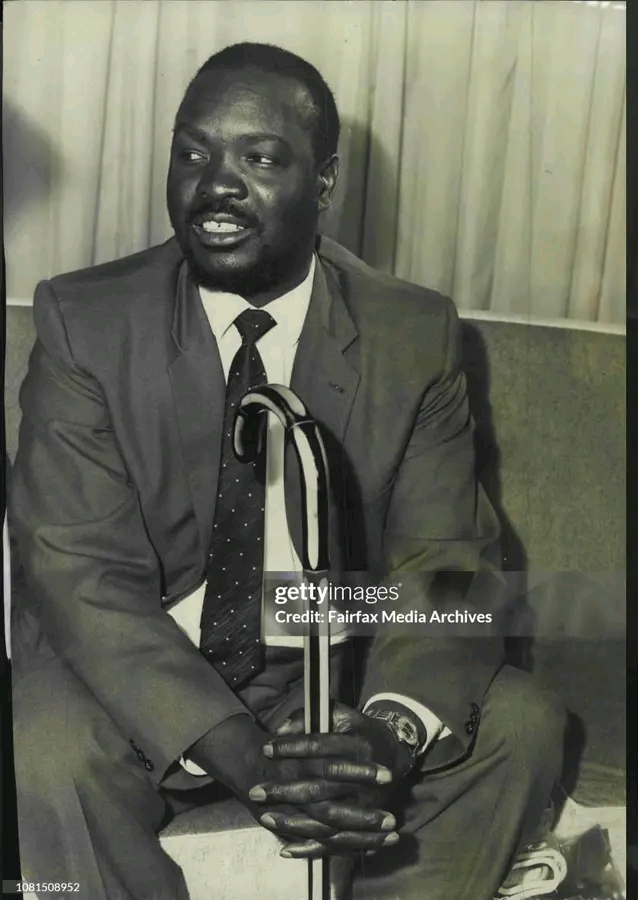
JUSTIN HENRY CHIMBA—THE FREEDOM FIGHTER WHO EVENTUALLY FELL OUT WITH THE SYSTEM HE HELPED BUILD

Breaking News Zambia
NewsJUSTIN HENRY CHIMBA—THE FREEDOM FIGHTER WHO EVENTUALLY FELL OUT WITH THE SYSTEM HE HELPED BUILD Chimba belonged to the generation of nationalists who fought to end British colonial rule in Northern Rhodesia, only to discover that the politics of independence could be just as contentious as the struggle that preceded it. A trade unionist, administrator, […]
JUSTIN HENRY CHIMBA—THE FREEDOM FIGHTER WHO EVENTUALLY FELL OUT WITH THE SYSTEM HE HELPED BUILD
Chimba belonged to the generation of nationalists who fought to end British colonial rule in Northern Rhodesia, only to discover that the politics of independence could be just as contentious as the struggle that preceded it.
A trade unionist, administrator, nationalist and seasoned politician, he rose to become a member of Zambia’s first post-independence Cabinet before breaking ranks with the very political establishment he had helped bring to power
Born in 1921 in Mporokoso, Northern Province, during the colonial era, Chimba grew up at a time when educational and professional opportunities for Africans were severely constrained by the racial inequalities of the colonial system.
Like Kenneth Kaunda and several other prominent figures in Zambia’s early nationalist movement, he attended Lubwa Mission, a Scottish Presbyterian institution that produced many of the country’s pioneering political and intellectual leaders. He distinguished himself academically, obtaining an Overseas Cambridge Certificate, an achievement of considerable significance in the circumstances of the time.
Before entering full-time politics, Chimba worked as a clerk in the colonial Provincial Administration, commonly known as the Boma. His experience exposed him to the machinery of government, administrative procedures and the practical business of public service. Ironically, the colonial administration was training a man who would eventually help administer the independent state that replaced it.
His political awakening was closely linked to the labour movement. Through his involvement with clerical workers’ unions, Chimba became increasingly concerned with wages, working conditions and the advancement of Africans in a system that offered them limited opportunities. His engagement with labour issues gradually developed into a broader commitment to political emancipation. After all, demanding better conditions was one thing; securing the political power necessary to change the system was another.
Chimba initially rose through the ranks of Harry Mwaanga Nkumbula’s African National Congress (ANC), serving as Provincial Secretary for the Eastern Province. However, like several younger nationalists who favoured a more radical approach to the independence struggle, he became dissatisfied with Nkumbula’s political direction.
When Kaunda and his colleagues broke away to establish the Zambia African National Congress (ZANC), Chimba joined the new movement. In 1959, the colonial government banned ZANC and arrested or restricted several of its leading figures. The authorities appeared to believe that suppressing a political organisation would also silence the grievances that had given rise to it.
Following his release, Chimba joined the United National Independence Party (UNIP), which became the principal vehicle for Kaunda’s independence campaign. He emerged as an important figure in the movement and undertook diplomatic work aimed at securing international support for Zambia’s liberation struggle, including assistance and educational opportunities for Zambian students.
By the time independence arrived in 1964, Chimba had established himself as a committed nationalist with experience in administration, labour organisation and political mobilisation. His journey from the colonial Boma to the nationalist movement had placed him among the men entrusted with the responsibility of building a new nation.
At independence in October 1964, Chimba entered the first Cabinet of the newly independent Republic of Zambia as Minister of Labour and Mines. It was a significant appointment in a country whose economy depended heavily on copper mining, an industry central to national revenue, employment and the country’s future development.
His responsibilities placed him at the intersection of labour relations and the mining sector, two areas of enormous importance to a government seeking to reshape the colonial economy. Zambia also faced the challenge of Zambianization, the gradual replacement of expatriate personnel with qualified Zambians in positions of responsibility across the public service and other sectors.
Chimba subsequently served in other ministerial capacities, including Justice, Commerce, Industry and Foreign Trade, and National Guidance. His movement across these portfolios reflected the broad responsibilities shouldered by the political leadership during the formative years of the republic, as the government attempted to transform inherited colonial institutions into instruments of national development.
Chimba also served as member of parliament for Liwingu West from 1964 to 1968 then Petauke Central from 1969 to 1973, all under UNIP.
He was part of a generation expected not merely to celebrate independence but to make it work. The task demanded administrative discipline, political judgement and the ability to navigate competing interests in a country confronting the enormous challenges of postcolonial state-building.
Yet, as Zambia’s early political history would demonstrate, service in government did not necessarily guarantee lasting political harmony. Nor did participation in the liberation struggle ensure that former comrades would agree on how independent Zambia should be governed.
By the early 1970s, disagreements within UNIP were becoming increasingly pronounced over political power, regional representation and the direction of the country. Chimba became increasingly critical of what he regarded as the marginalisation of leaders from Northern and Luapula provinces.
In 1971, he resigned from the government and UNIP and joined Simon Mwansa Kapwepwe in establishing the United Progressive Party (UPP), an opposition movement that challenged Kaunda’s increasingly centralised political order.
It was a reminder that the coalition of nationalists united against colonial rule had never been entirely free of competing ambitions, ideological differences or disagreements over political leadership. Independence had settled the question of who would govern in place of the colonial authorities, but it had not settled the question of how power should be exercised.
The UPP was soon banned, and its leading figures, including Chimba, were detained. The episode exposed one of the striking contradictions of Zambia’s early post-independence politics: men who had endured colonial repression in pursuit of political freedom could find themselves imprisoned again after challenging the government they had helped establish.
The principle of political freedom had been central to the nationalist struggle. Its application, however, became far more complicated when opposition threatened the authority of the post-independence leadership. Apparently, freedom of expression was an admirable principle until someone used it to disagree with those in power.
Following his release, Chimba largely withdrew from frontline politics. Unlike some former UPP figures who eventually returned to UNIP, he did not resume a prominent role in the ruling party.
Chimba died in May 1995, leaving behind a place in the history of Zambia’s independence struggle and the political development of its early republic.
His story deserves attention not only because he served as a minister in the first government, but also because his career illustrates the difficult transition from liberation politics to the realities of governing an independent state.
The nationalist movement had been united by a common objective: ending colonial rule. Once that objective was achieved, differences over representation, political authority and the future direction of the country became harder to contain.
Chimba’s experience also raises an enduring question about the meaning of independence. Was it enough to transfer power from colonial rulers to African leaders, or did genuine freedom also require tolerance for dissent, competing political ideas and the right of former comrades to challenge those in government?
Sometimes, the hardest battle for a freedom fighter begins after the flag has been raised. The colonial masters may have departed, but the struggle over power, representation and the right to disagree can continue long after independence as we have continued to witness in our politics today.
More often than not, the former comrades end up fighting over who gets to hold the microphone.
In the picture courtesy of Getty Images, Chimba as Minister of Justice attending the Third Commonwealth Empire Law Conference in 1965 in Australia.


Community Feedback