
WHY A COPPER MINE IS TEACHING ZAMBIA’S YOUNG LEARNERS TO CODE

Breaking News Zambia
NewsWhy is a copper mine in North-Western […]
Why is a copper mine in North-Western Zambia teaching teenagers to build neural networks? How is artificial intelligence, a technology most associated with Silicon Valley, finding its way into a school hall in Solwezi, and what does it mean for the future of work in a country where copper is king? Who, in a region where the chalkboard still rules, is building the technological capacity to ensure Zambian children become the architects of the AI revolution rather than its bystanders? The answer is taking shape in Solwezi, with Kansanshi Mining PLC, Zambia’s largest copper producer, a subsidiary of First Quantum Minerals, which believes that the future of mining, and of Zambia itself, will be written in code.
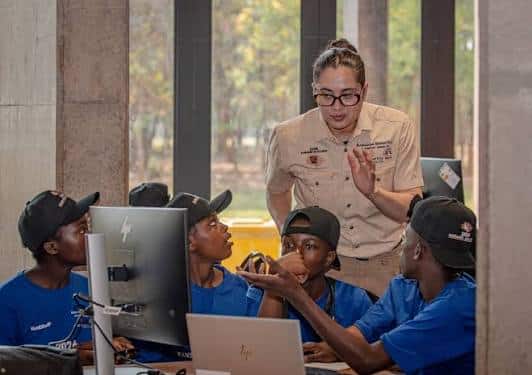
For two days, 105 pupils from 21 schools and a team from Copperbelt University gathered at Trident College’s Philip Pascall Hall, racing to build AI models that solve real mining problems: safety reporting, equipment monitoring, smart checklists and ore classification. Now in its second year, the Kansanshi Education AI Hackathon is a staging ground for the engineers, geologists and data scientists the mine will need tomorrow – and for the jobs of the future.
“Today is not just a hackathon. It is a statement that education in North-Western Province is moving from the chalkboard to the global stage of artificial intelligence,” said Senior Education Standards Officer for Examinations in North-Western Province, Dr Katende Vecster, standing in for the Provincial Education Officer.
Dr Katende, who holds a PhD in education focused on AI and cybersecurity, believes the technology amplifies teachers rather than replaces them. “People who do not use AI will be replaced by people who use AI,” he said. “We still need the human in the loop, especially for some decisions. The key thing is that people should learn AI and use it to be productive.”
Kansanshi is helping to build the technological capacity the region has long lacked: 22 teachers trained in AI methods and, through the Kansanshi Education Quality Improvement Programme, donated 430 computers to Solwezi schools over the past two years. In the latest phase, 105 computers went to five schools in the mine’s catchment area, while Copperbelt University received 60 computers, three servers, and 14 Cisco Network switches.
Kansanshi Mining PLC Assistant General Manager Axel Kottgen views education as the country’s lifeline.
“If we are to move forward as a country, we must keep developing and create opportunities, employment, jobs, and businesses. That can only come through education,” he said. He pointed to ChatGPT’s arrival a few years ago as proof of how quickly work is being redrawn.
“It’s changing the face of work, changing the face of life. It’s becoming a very important skill for people to master as we move into the future,” he said.
“It’s pointless that we just run the mine and then, when the mine is no longer there, there is nothing behind us. We need to leave a future,” added Mr Kottgen. That long view is the Kansanshi Foundation’s trade. The Foundation manager, Simon Keevil, jokes that he is ‘BBC’ Born Before Computers, while his young coders are ‘AC’, born after them. “It’s not just about computers; it’s a life lesson you’re learning today,” he told them.
“You’re trying to solve a problem with code. Sometimes it doesn’t work. You break the code and go back again.” For an industry where safety systems are core to operations, a fresh perspective matters. “It’s always very important to get these solutions coming from fresh minds,” said FQM Trident ICT Operations Lead and Chairperson of the Information and Communications Technology Association of Zambia’s (ICTAZ) Northern Region, Mutembo Ebo Mpengula.
“It’s sometimes difficult for professionals like us to see things from a different lens. We see things from a different lens coming from the students.”
Infrastructure is another hurdle: without reliable power, internet and computers, even the most ambitious AI curriculum cannot get off the ground. Kansanshi Mining PLC IT Operations Superintendent Patricia Moyo said the company assessed schools’ infrastructure before providing the computers now being used by pupils.
“The AI tools provide participants with much-needed exposure to the possibilities of artificial intelligence in industry. They demonstrate how technology can be applied to solve real-world challenges and inspire young people to develop innovative solutions to issues facing our communities, businesses and the world today.”
For Copperbelt University Dean of the School of Information and Communication Technology, Professor Josephat Kalezhi, the donation of servers, desktops, and network switches comes at a critical time as student numbers surge at the institution.
‘We are not merely receiving equipment. We are receiving tools of transformation, tools that will shape minds, unlock potential, and build the human capital that Zambia needs to compete in a 21st-century knowledge economy.”
The Hackathon saw an increase in the number of participating schools from 14 in 2025 to 21 this year, including university students and learners at different stages of education, united by one question: how can technology solve real-world problems? The winners reflected that widening ambition. Solwezi Trades Secondary School took first place in the Government Secondary School category, ahead of Solwezi Day Secondary School in second place and Kyawama Secondary School in third place.
In the Tertiary category, the Copperbelt University received special participating award as the sole participant while Sentinel Kabitaka and Trident College shared first place in the Private School category. The top three government schools each won a laptop, a 55-inch television, and K500 per student, while their teachers won a K1,000 grocery voucher. Overall, they walked away believing the future is one they can code.
The hackathon was an impressive technology showcase by the three top government schools, who have now been invited to take part in Young Innovators Day at the end of October 2026, organised by the ICTAZ. The prizes mark the end of the competition, but the bigger test begins beyond the hall.
As work changes, the distance between a school computer laboratory and a technology-driven mine keeps shrinking, and the hope is that some of today’s pupils will one day walk through the mine’s gates not simply as employees, but as the engineers, scientists, and technology specialists shaping what comes next.
Article by FQM Zambia




Community Feedback