
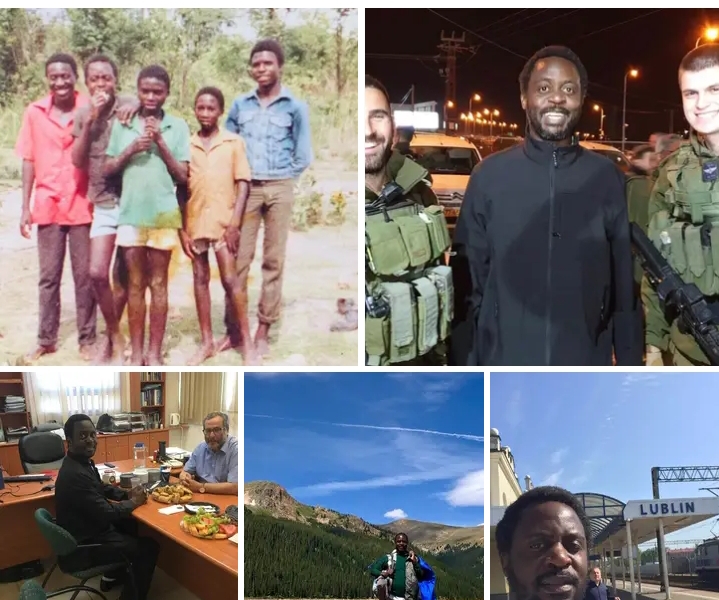
THE BOY WHO ADDRESSED THE TREES: MY DREAMS OF KAUNDA, THE MILITARY AND THE REPUBLIC

Breaking News Zambia
NewsTHE BOY WHO ADDRESSED THE TREES: MY DREAMS OF KAUNDA, THE MILITARY AND THE REPUBLIC Some dreams begin long before we understand the responsibilities they will eventually place upon our shoulders. Mine began in childhood, with a fascination for the Republic of Zambia, the men and women who defended it, and a President whose leadership […]
THE BOY WHO ADDRESSED THE TREES: MY DREAMS OF KAUNDA, THE MILITARY AND THE REPUBLIC
Some dreams begin long before we understand the responsibilities they will eventually place upon our shoulders. Mine began in childhood, with a fascination for the Republic of Zambia, the men and women who defended it, and a President whose leadership captured my imagination.
I grew up in Kasama, in a family whose history was deeply connected to Zambia’s struggle for independence, military service and traditional leadership. My grandmother on the paternal side, Mama Julia Mulenga Chikamoneka, belonged to the generation of freedom fighters who sacrificed for the birth of our Republic. My grandfather, Sergeant Dominic Musoma, was a decorated soldier who fought on the side of the Allied forces during the First World War. His distinguished military service formed an important part of our family’s heritage and contributed to my early admiration for the armed forces.
On my maternal side, my grandmother, Her Royal Highness Theresa Bwalya Chitimukulu, also shared fascinating accounts of the liberation struggle. She was a daughter of my great grandfather, His Royal Majesty Chitimukulu Kanyanta Manga I, and recalled how Dr Kenneth David Kaunda and other nationalist leaders were sometimes secretly sheltered within her father’s royal palace during the struggle against colonial rule.
My grandmother personally prepared meals for these freedom fighters while they remained in hiding. The palace provided a measure of protection because the Federal Police were reluctant to enter and search the private quarters of traditional royalty. While the colonial authorities searched for the nationalist leaders, some of them were being sheltered and fed within the very palace of the Chitimukulu. These were not stories I encountered merely in history books. They were family accounts passed down by people who had personally witnessed or participated in those extraordinary events. Patriotism, military service, courage and the defence of our people’s dignity were therefore part of my upbringing.
As a young boy, I was also enthralled by President Kenneth David Kaunda. To me, he was more than the Head of State. He represented the authority, dignity and aspirations of the young Republic. In fact, I thought “Kaunda” was a profession. Whenever I had an opportunity to see him during his annual conferences in Northern Province in Kasama at Natende along Lukupa River, the experience left a lasting impression on my young mind.
I admired his manner of speaking, his confidence and the way he addressed the nation. I watched and listened carefully. I was particularly mesmerised by his vision of national development, including the Rural Reconstruction Centres and the broader ambition of building a productive and self reliant Zambia. My admiration was so immense that I began imitating him.
As a child, I would stand before trees and address them as though they were citizens gathered at a public rally. The trees became my audience. I would deliver speeches, make pronouncements and imagine myself speaking to the nation. There were no cameras, microphones or cheering crowds. There was simply a young boy with an extraordinary imagination and a growing sense that his life would somehow be connected to public service. Looking back, those childhood experiences were more significant than I realised at the time. They were the earliest expressions of an interest in leadership, the State and the responsibilities that accompany national service.
Politics was not my only fascination. I was equally attracted to the military. I admired military uniforms, the discipline of soldiers, the command structure and the sense of purpose associated with serving one’s country in uniform. I was interested in the Zambia Army and the wider defence and security establishment. I wanted to understand how a country organised itself to defend its sovereignty, protect its people and preserve its institutions.
When I completed secondary school, I decided to pursue that ambition. I went personally to Arakan Barracks, the Zambia Army Headquarters in Lusaka, to apply to join the Army as an officer. There had been no recruitment advertisement, but I was determined to submit my application. The military personnel were remarkably professional. They received me courteously and explained that recruitment for officers was conducted through the Officer Selection Board, whose announcements were published in the newspapers. I was advised to look out for those advertisements.
I understood the explanation, but I had already made up my mind. I told them that, since I was already there, I might as well submit my application. They graciously allowed me to do so. At the registry, a sergeant who was receiving my application asked whether I wanted to join as an officer cadet. I immediately corrected him. “No, no! I was already a cadet at school. I don’t want to be a cadet. I want to be an officer!” Everybody in the registry burst into laughter.
I could not understand what was so amusing. I was perfectly serious. I wanted to become a commissioned officer, and I was making my intentions absolutely clear. What I did not know was that officer cadets are precisely the people undergoing training to become commissioned officers! In my youthful understanding, the word cadet referred to something below the status I was seeking. Having already been a cadet at school, I had no intention of returning to what I imagined was the same level.
The sergeant and his colleagues understood the military system. I did not, but I was confidently correcting the very people who knew better! I submitted my application, but I never received a response from the Zambia Army. My military ambitions, however, remained alive.
Eventually, I saw an advertisement inviting applications for officer selection in the Zambia Air Force. This immediately attracted my attention because, beyond simply becoming an officer, I had another ambition. I wanted to become a fighter pilot. I imagined myself flying military jets, defending Zambia’s airspace and serving the Republic from the skies. I applied without knowing anybody in the system. I was shortlisted and subsequently attended the aptitude tests conducted by the Zambia Air Force at the Lusaka Trades Institute. I thoroughly enjoyed those tests. To me, they were relatively easy, and I approached them with considerable confidence.
I was progressing towards what I believed would be the fulfilment of my military ambition, but there was something rather amusing about my understanding of military life at that stage. I was especially enamoured of the privileges and prestige that came with being a military officer. I had observed how officers received salutes from other ranks, and I found that particularly attractive. In my young mind, becoming an officer meant that people would salute me, I would fly fighter jets, and in the evenings I would retire to the Officers’ Mess to socialise and enjoy the company of fellow officers.
The Officers’ Mess held a special appeal to me. I imagined the camaraderie, the social life and the dignity associated with belonging to that institution. That was my rather idealised picture of military service. I was concentrating on the destination without fully understanding the journey. Then came the pre entry physical assessment at Zambia Air Force Headquarters. That was where my glamourised picture of military life encountered reality!
I was physically very fit, as I have remained throughout my life. The challenge was not my physical fitness but my lack of mental preparation for the rigours of military training. Indeed, I remain deeply grateful to G-d, the Almighty, for the blessing of good health throughout my life. By His grace, I have never been hospitalised, something I neither overlook nor take for granted. My difficulty at the Zambia Air Force Headquarters was therefore not physical incapacity.
What frightened me even more was the presence of the sergeants and other non commissioned officers who were supervising the activities. There were sergeants everywhere! From the moment we entered, we encountered these tough, disciplined men who clearly meant business. They were responsible for putting us through the physical exercises and assessments. I began wondering why we were being placed in their hands. In my mind, I was supposed to become an officer. Why, then, were we not being handled by fellow officers?
I looked around and saw more sergeants than commissioned officers. Then another thought occurred to me. These were the very men who would eventually be saluting us once we became commissioned officers, but for the moment, they had complete authority over our physical assessments. I began imagining what they might put us through before we ever reached the stage of receiving those salutes. The exercises were demanding, the instructors were tough, and my confidence began to evaporate.
I realised that I had been attracted to the prestige of military service without properly researching the training, discipline, physical endurance and sacrifices required to attain that position. By the third or fourth day, I had reached my own private conclusion. I was not going to survive this! So, without any ceremony or formal announcement, I quietly disappeared. Yes, I effectively demobilised myself from the Zambia Air Force selection process! Nobody discharged me. Nobody dismissed me. I simply decided that the road to becoming a fighter pilot was considerably more demanding than the picture I had constructed in my imagination. My military career ended before it had even begun.
Today, I can laugh about that experience, but it taught me an important lesson that I would like young people to appreciate. Before pursuing any profession, research it thoroughly. Understand its entry requirements, training, responsibilities, sacrifices, risks and the discipline necessary to succeed. Do not become so fascinated by the privileges of a position that you overlook the demands of attaining and holding it. I had wanted the salutes, the fighter jets and the Officers’ Mess. I had not sufficiently considered the rigorous training that stood between me and those privileges.
Some of the individuals who were in that intake subsequently progressed through the military ranks, with some attaining the rank of Brigadier General. Had I persevered, perhaps I too might have followed that path, but life took me in another direction. Alongside my military ambitions, I had developed a deep intellectual curiosity about the world of intelligence. I was deeply interested in the work of intelligence officers, the collection and analysis of information, the identification of threats, the protection of national interests and the ability of a State to anticipate dangers before they materialised.
I had an uncle who was a very senior intelligence officer. At the time, he was second in command of the intelligence service in Lusaka Province. Naturally, I thought he might help me find my way into the intelligence profession. I approached him and expressed my interest in joining the service. To my disappointment, he dismissed the idea. His assessment was that I did not possess the qualities required of an intelligence officer. He did not appear particularly interested in helping me pursue that ambition. Looking back, I believe my uncle missed something important about my personality.
During part of my upbringing, I was quite introverted. I was a quiet young man who spent considerable time reading, researching, observing and trying to understand things. I was not particularly talkative. I preferred to listen, study and think carefully before expressing myself. I was also a concrete thinker. I disliked unnecessary abstractions and preferred clarity, precision and explanations that could be understood in practical terms.
That characteristic has remained with me. Even today, when explaining complicated subjects, I sometimes go into considerable detail because I want people to understand precisely what I mean. I dislike leaving important concepts suspended in vague or abstract language. Of course, I can write abstracts and engage with abstract reasoning. My preference, however, has always been to translate complex ideas into clear, practical understanding.
My uncle may have formed his assessment from what he observed at the time, but I do not believe he fully appreciated my intellectual interests, temperament or capacity for research and analysis. In retrospect, I think he underestimated me. Intelligence work is not simply about secrecy or the ability to remain silent. It also demands observation, analytical discipline, intellectual curiosity, patience, sound judgement and the capacity to distinguish significant information from irrelevant detail. Those were precisely the intellectual pursuits that stimulated my curiosity and captured my interest. Nevertheless, I did not join the intelligence service.
My interest in security, however, never disappeared. My professional career, spanning nearly three decades in senior management and executive leadership, took me into international development, where I headed international organisations and undertook major consultancy assignments involving multinational institutions, including the United Nations and the now defunct USAID. One organisations I led operated in several countries, while another, which I was tasked with establishing in Zambia, had a presence in over 100 countries. Such responsibilities demanded a broad understanding of global affairs, geopolitical developments and security environments. Consequently, security awareness and risk assessment became practical necessities and, over time, second nature to me.
As life unfolded, I travelled to different countries and regions and encountered circumstances in which an understanding of security was not merely an academic interest but a practical necessity. There are environments in which people grow up with an acute awareness of danger, personal security, situational awareness and the need to understand their surroundings. In some communities, even children acquire an instinctive appreciation of security because of the realities of the environments in which they live. Through my travels, experiences and professional engagements, I came to appreciate these realities in ways I could never have anticipated during my youthful attempts to join the military and intelligence services. In a sense, I eventually encountered the world of security through a different route.
My interest expanded into military organisation, intelligence systems, counterintelligence, strategic decision making, national defence, civil military relations, security technology and the relationship between national security and political leadership. I became increasingly interested in how states develop the institutional capacity to anticipate threats rather than merely respond to crises after they occur. I also came to appreciate that national security extends far beyond soldiers, weapons and intelligence officers. It includes economic resilience, technological capability, food security, energy security, institutional competence, national cohesion and the protection of critical infrastructure.
These interests have continued to shape my thinking and writing. When I publish articles under my Defense File series, discussing intelligence, military effectiveness, strategic surprise, defence production, technology and the security responsibilities of the State, I am addressing subjects that have captured my interest and engaged my intellect since my youth.
My interest did not begin with politics. It began with a young boy who admired the institutions of his country, imagined himself wearing a military uniform, dreamed of flying fighter jets and hoped to serve within the intelligence establishment. Life eventually took me along a different path. Instead of becoming an Army officer, an Air Force fighter pilot or an intelligence officer, I entered public life and politics. The underlying motivation remained remarkably consistent.
There is something important about the dreams we carry from childhood. Not every dream is fulfilled in the form in which we first imagined it. Sometimes its purpose is fulfilled through an entirely different calling. The young boy who addressed trees in Kasama could not have known the journey that lay ahead. He could not have anticipated the responsibilities, challenges, disappointments and opportunities that would eventually define his public life, but he believed in Zambia, and after all these years, I still believe in the immense possibilities of our Republic.
A nation must never stop producing young people who dream of serving it. Some will become soldiers, some intelligence officers, some scientists, engineers, teachers and entrepreneurs, and others political leaders. What matters is that their ambitions are anchored in service to something greater than themselves. The Republic belongs not only to those who lead it today, but also to the children who are presently dreaming about what it could become tomorrow.
Saviour Chishimba
Member
UPND Alliance Council of Presidents
President – United Progressive People (UPP)

Community Feedback