
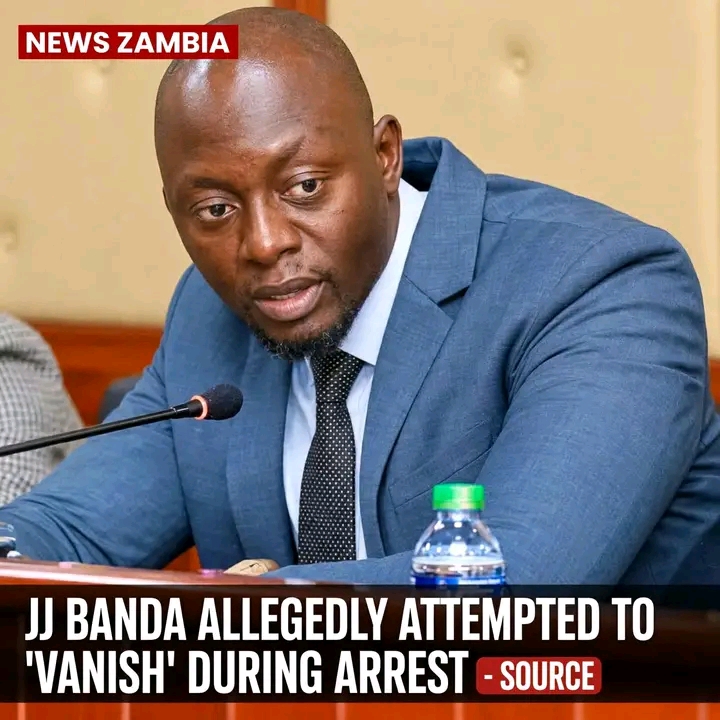
Jay Jay Banda Is a Fugitive From Justice, Not a Prisoner of Conscience

Breaking News Zambia
NewsThe full article as published in the Daily Mail. Jay Jay Banda Is a Fugitive From Justice, Not a Prisoner of Conscience By Whitney Mulobela Emmanuel “Jay Jay” Banda is back in Zambia, and the criminal case he walked away from in 2024 can finally proceed. Amnesty International and some of his political allies have […]
The full article as published in the Daily Mail.
Jay Jay Banda Is a Fugitive From Justice, Not a Prisoner of Conscience
By Whitney Mulobela
Emmanuel “Jay Jay” Banda is back in Zambia, and the criminal case he walked away from in 2024 can finally proceed. Amnesty International and some of his political allies have chosen to present him as a government critic in need of protection. However, the facts tell a different story, and they deserve to be set out clearly.
It is on record that in August 2024, Banda was in lawful custody at Chipata General Hospital, where he was being treated while awaiting trial on charges that included attempted murder and aggravated robbery. These where clearly criminal charges and not political, nobody had detained him for his politics. He was an accused person going through the ordinary criminal process, and the medical care he received was part of the state’s duty towards anyone in its custody. He used that care to escape from custody. In July 2025, with Banda still at large, the case was committed to the High Court for trial, and he remained a fugitive for more than two years.
His return followed cooperation between police services in the region. In mid-October the Zimbabwe Republic Police (ZRP) announced it was working with Zambian authorities to locate Banda and several other suspects wanted in Zambia for various offences. On 16 October 2026, Zambia Police confirmed that he was in the country and would be formally charged with attempted murder, aggravated robbery and escaping from lawful custody.
Several of Amnesty International’s points are correct and the government accepts them without hesitation. Banda is entitled to medical treatment, to see a lawyer in confidence, to have contact with his family and to be brought before a court promptly. Our Constitution guarantees each of these rights to every accused person, and he is no exception.
Where Amnesty International goes wrong is in the picture it paints. Its statement introduces Banda as a “government critic”, raises the principle of non-refoulement as if he were a refugee, and asks Zambia to “promptly either facilitate the release” of Banda or establish lawful grounds for holding him. Lawful grounds existed well before he fled, in the form of a committal to the High Court, and his escape added a further charge. Suggesting release as an option for someone who broke out of custody while awaiting trial simply ignores the escape.
The refugee argument is equally weak. We are aware of no record showing that Banda ever applied for asylum in Zimbabwe, Mozambique or anywhere else. Refugee protection is meant for people escaping persecution, and Article 1F of the Refugee Convention specifically excludes those who there are serious reasons to believe committed a serious non-political crime before seeking refuge. Banda never sought that protection in the first place. He has been returned to his own country to stand trial before its ordinary courts, with his constitutional rights intact.
His standing as a former MP and an opposition voice does not change any of this. Zambians are free to criticise their government, and many do so every day without fear, it is their constitutional right. That freedom has never meant that a politician who faces criminal charges can avoid answering them. Treating every prosecution of an opposition figure as political persecution does a disservice to the many critics who obey the same laws as everyone else.
Amnesty International’s statement is also silent on matters that others in the human rights community consider important. Zambian human rights advocate Sikaile Sikaile, who has worked with Amnesty International for more than a decade, has written publicly asking the organisation to examine documented allegations about Banda’s conduct. These include a reported assault on journalist Peter Sukwa ahead of the 2016 elections and broadcasts in which, according to Sikaile, Banda called for the killing of President Hakainde Hichilema and the elimination of members of the Tonga community. Allegations of this kind have to be properly investigated and tested before anyone draws conclusions. Even so, an assessment that considers the rights of the accused while overlooking those of alleged victims is incomplete.
The complainants in the original case have now waited more than two years. They should be able to give their evidence without intimidation and to have it heard without further delay, while Banda must have every chance to contest it. A fair trial requires both.
Should Banda or his lawyers wish to dispute the circumstances of his return, they can take the matter to the High Court, and the state will need to answer there with evidence before a judge. Legal questions of this kind belong in the courts rather than in press releases.
Let me hasten to say, Banda is not a prisoner of conscience. He is an accused man who spent more than two years avoiding a trial and who must now face it. His rights will be respected throughout, as will the rights of the people who brought the complaints against him. The law applies equally to government supporters and opposition figures, and this case should be no different.
Whitney Mulobela is Chief Communications Strategist at State House, Zambia.


Community Feedback