
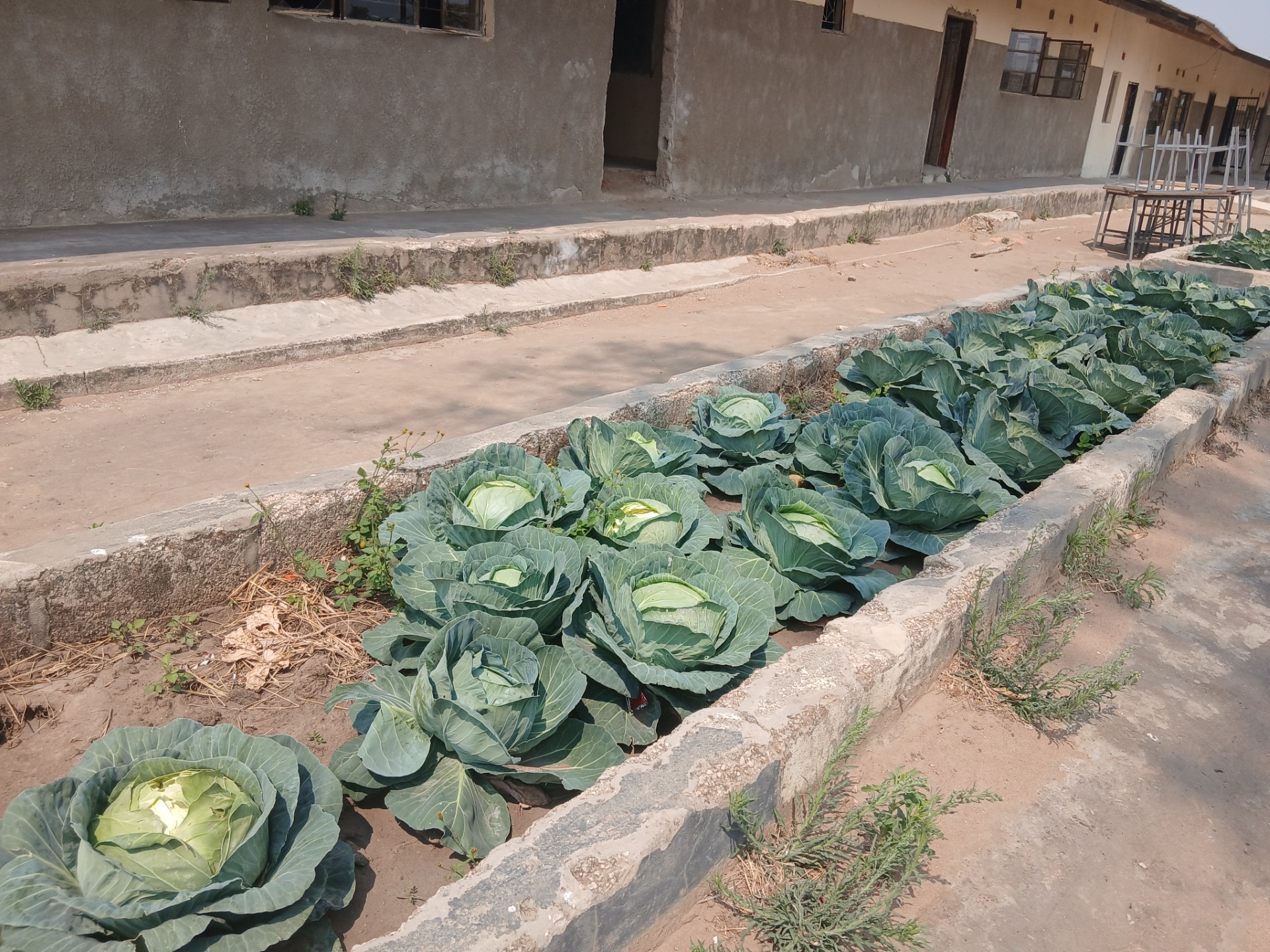
From flower beds, to cabbage farming

Breaking News Zambia
NewsBy Naomi Mwimba When public schools across Zambia opened for the third term on 7th September 2026, it was just a normal day for many pupils; catching up with friends on how the holiday was, while teachers prepared how to deliver lessons to pupils for the new term. However, the opening day at Mununga Day […]
By Naomi Mwimba
When public schools across Zambia opened for the third term on 7th September 2026, it was just a normal day for many pupils; catching up with friends on how the holiday was, while teachers prepared how to deliver lessons to pupils for the new term.
However, the opening day at Mununga Day Secondary School in Lavushimanda District, Muchinga Province, was rather different in that teachers and learners, after lessons, went for something unique; harvesting about 1,500 heads of cabbage under the school production unit.
The cabbage was planted three months earlier on a 20 by 20 school land, and the school vegetables were under proper care even during the August holiday, as learners were given specific dates to go to the school and take care of the cabbages, giving them practical skills in agriculture.
The activity is one example of how schools are responding to the Competency-Based Curriculum (CBC), which the Ministry of Education rolled out starting in 2025, replacing the 2013 Outcomes-Based Education (OBE) curriculum. This new curriculum places greater emphasis on practical skills, competencies, innovation, entrepreneurship, and the ability of learners to apply knowledge to real-life situations.
It encourages schools to establish production spaces where learners can be equipped with practical experience in areas such as agriculture, creative arts, fashion and design, entrepreneurship, business, and financial literacy.
While many technical and STEM schools already have facilities that support practical learning, some schools without infrastructure, available resources such as land can provide an important starting point for implementing practical aspects of the curriculum, and this is exactly what Mununga Day Secondary School has done.
Instead of allowing the school’s vast land to lie idle, teachers at Mununga Day Secondary School have utilized it for a production unit. The school has also used part of the land around the school used as flower beds to plant cabbage, and it is from this same place where the school has harvested the 1,500 heads of cabbage.
Land preparation for this project was done in May 2026 and thereafter other requirements such as seeds, pesticides and other chemicals, and fertilizer were procured all costing about K3150. Planting was done in the same month (May) while pupils provided free labour.
School Head Teacher Charles Kapyata indicated that the school was inspired to undertake this project after realizing that it was wasting a lot of water from the solar powered borehole drilled for the school under the Constituency Development Fund (CDF). He said the school was only using the water for watering flowers and decided to remove them and replace them with cabbages. His statement caught the attention of this reporter, who realized that this was thinking outside the box, as espoused in the Competence Based Curriculum which the school is implementing.
The head teacher explained, ““The current Competence-Based Curriculum is a hands-on curriculum, as it allows learners to physically practice what they are taught, so we are using production units to teach our learners and make them practice real agriculture, such as gardening, and we encourage them to come up with small gardens at their home since they now have the skill,” he said.
Some of the harvested heads of cabbages were taken to the market for sale, and the school was expecting to raise about K15,000 from the sales, as each head was selling between K10 to K30 depending on the size. The school will also use the other cabbages to feed about 80 girls who are in the weekly boarding at the school.
School Production Unit Coordinator Mwiche Chisanga disclosed that the school spent about K3,150 and this expenditure includes K400 for purchasing seeds, K550 for purchasing pesticides, and K2,200 for the fertilizer. He said the school is expected to make a profit of over K10,000 but pointed out the slow market as the only barrier to realizing this profit margin.
Despite the marketing challenge, the project has demonstrated that a modest investment can generate income while simultaneously providing learners with practical skills.
And for learners at the school, the knowledge attained through this venture is life-changing. School head girl Gwen Chanda stated that the project has equipped her with skills to grow cabbage from nursery to management and promised to implement the skill at home. She said undertaking such a project at home can assist her parents in reducing the cost of buying vegetables every day as well as use the skill learned for her own survival when she completes her secondary education.
“I think I will start a serious gardening project after completing school so that I can also be selling some for my own survival now that I have acquired the skills in gardening,” she says.
Mununga Day is also among the four schools in the district that has been funded to implement the Presidential Irrigation Initiative Program (PIIP) by growing winter maize on at least one acre of land. School head teacher, Mr Kapyata, who is grateful to the government for the gesture, said learners are also fully involved in the implementation of this program, as it is an addition to the already existing PU also linked to the CBC, whose skill also borders on agriculture.
Planning Officer at the Lavushimanda District Education Board Secretary’s Office (DEBS), Monday Sikanyika also shared that other schools in the district, including Lukulu Day Secondary, Salamo Day Secondary and Mununga Primary schools, have been fully funded to implement the Presidential Irrigation Initiative Programme (PIIP).
The involvement of schools in irrigation and crop production is providing learners with additional opportunities to understand agriculture not only as a subject but also as a potential business. It will also revive production units in schools, which is not entirely new but something that has existed for years. However, the renewed emphasis on production units under the competency-based curriculum is giving such activities a new significance.
The PIIP project and the PU is not only helping schools to produce crops or generate income but creating opportunities for learners to develop practical skills and giving them an understanding of how the knowledge from both classroom and practice can help them to solve real-life problems.
It is therefore important that innovation by schools like Mununga Day Secondary on the Production Unit should be emulated by most schools across the country. It can assist in boosting nutrition in schools, especially since the government is implementing the school feeding program, and instead of entirely waiting for government to fund such programs, schools can use the vegetables and maize that they are producing to feed learners, including those in boarding schools.
And by engaging in such ventures, such as maize and cabbage, the school will generate much-needed income that can help the institution meet its other needs, and contribute to the government’s target of achieving 10 million tons of maize by 2031.
More importantly, learners will leave school with practical skills that can be used to establish small businesses and create livelihoods.
The challenge now is for schools to identify the resources available to them and turn those resources into opportunities for learning and production.
At Mununga Day Secondary School, a piece of land that once had limited productive use is now a classroom, a garden, a source of food and a potential source of income.
And as Zambia implements the Competency-Based Curriculum, such examples demonstrate how education can increasingly move beyond memorizing knowledge towards developing young people who can use what they learn to produce, innovate, and solve problems in their communities




Community Feedback