
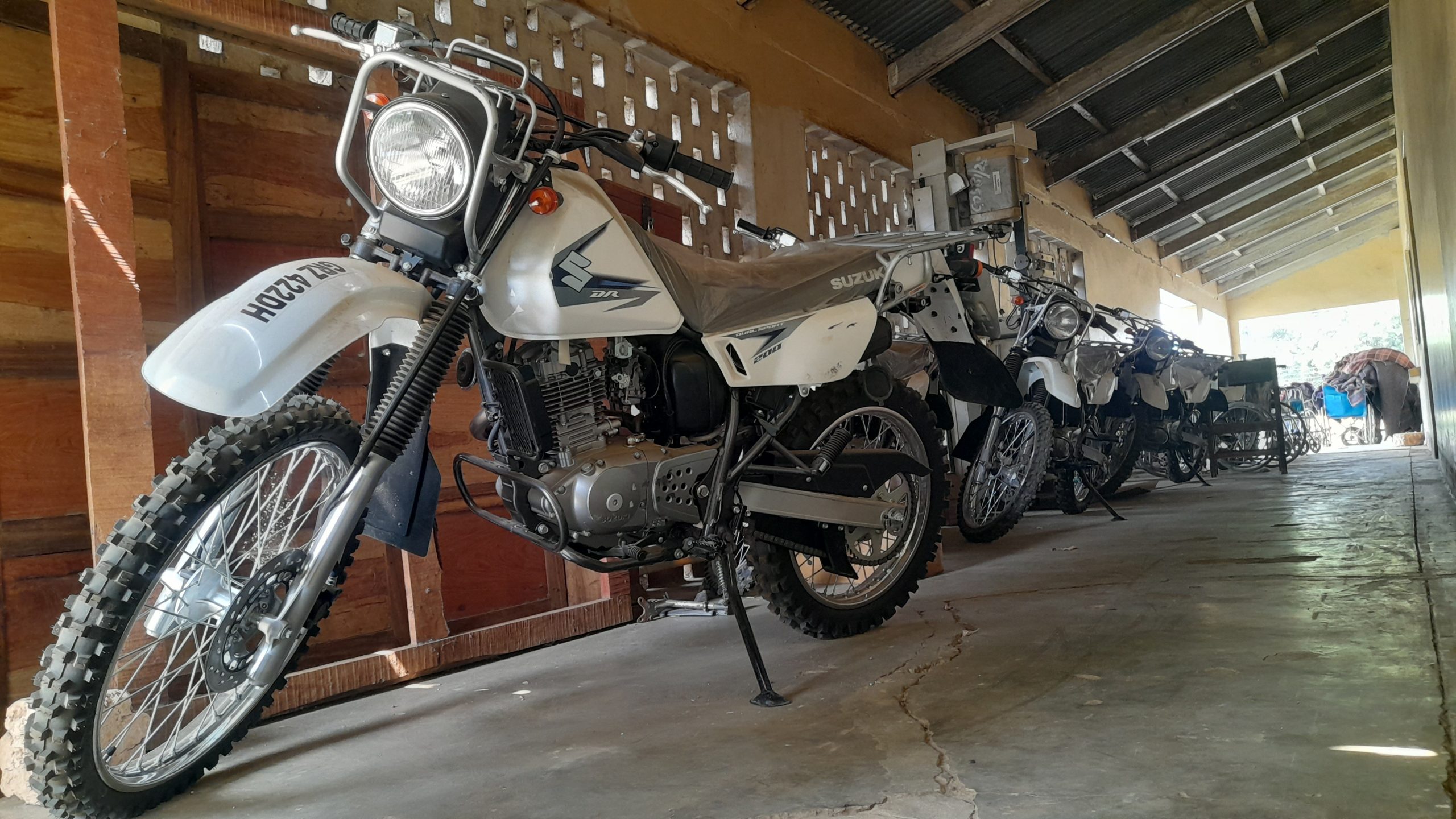
EU boosts healthcare delivery in Zambezi

Breaking News Zambia
NewsBy Chileshe Kafeshi Government efforts to improve healthcare delivery in hard-to-reach rural areas have received a major boost following the official handover of five utility motorbikes under the “Equal Chances for Human Development” (EC4HD) programme to the Ministry of Health in Zambezi District, North-Western Province. The transport donation was made by the […]
By Chileshe Kafeshi
Government efforts to improve healthcare delivery in hard-to-reach rural areas have received a major boost following the official handover of five utility motorbikes under the “Equal Chances for Human Development” (EC4HD) programme to the Ministry of Health in Zambezi District, North-Western Province.
The transport donation was made by the United Nations Children’s Fund (UNICEF) with financial support from the European Union (EU) as part of a £50 million health sector package aimed at strengthening service delivery across 10 EU-supported health facilities in the district.
The arrival of the motorbikes in Zambezi District immediately addresses severe geographical barriers that have historically prevented thousands of rural residents from accessing timely maternal care, child immunisations, and essential life-saving medicines.
Located approximately 520 kilometres west of Solwezi along the Mutanda–Chavuma Road (M8), Zambezi District has a projected 2026 population of 120,542 people. The District Health Office oversees 41 health facilities comprising one Level One Hospital, two mini-hospitals, nine rural health centres, two hospital-affiliated health centres and 26 health posts.
Geographic distance, poor road networks, and rough terrain remain the primary obstacles to healthcare access in Zambezi District, where the population is spread sparsely across vast plains, thick forests, and riverine terrain.
Out of the total district population, official health metrics show that approximately 45,000 residents living in urban and peri-urban wards in the district, have relatively easy access to health services, while over 95,000 residents dispersed across deep rural wards do not easily access basic medical attention.
Communities located in remote catchment areas across Zambezi West and far-flung parts of Zambezi East have historically faced extreme travel distances.
Villagers in hard-to-reach places such as Liyovu, Muyembe, Nyakulenga, and Kucheka routinely cover distances ranging between 25 and 45 kilometres on foot or using ox-carts simply to reach the nearest health post or rural health centre.
During the rainy season, some roads become completely impassable because of flooding, with referrals in some areas taking as long as three days.
These challenges particularly affect pregnant women, children, adolescents and elderly people, contributing to delayed presentation of severe illnesses, home deliveries, lower immunisation coverage, and difficulties in maintaining regular care for people living with chronic conditions such as HIV and hypertension.
In critical medical emergencies, such as obstructed labour or severe malaria in young children, these long distances have consistently caused preventable complications and tragic loss of life before patients could reach medical assistance.
Thirty-two-year-old Grace Kasoma, a mother of four from Muyembe village located over 40 kilometres from the nearest fixed health clinic, explained the severe challenges rural women have experienced during pregnancy and childbirth.
Mrs Kasoma explained that pregnant women in her area walked for nearly eight hours or relied on ox-carts over bumpy sand tracks to access antenatal checkups and delivery facilities.
She noted that many expectant mothers opted to give birth at home under the care of traditional birth attendants due to the physical exhaustion of traveling long distances while in labour.
Mrs Kasoma said the situation worsened during the rainy season when flooded plains and thick mud rendered key access roads completely impassable by standard motor vehicles.
She explained that the physical delivery and arrival of the utility motorbikes has transformed the lives of expectant mothers and young children who previously felt isolated due to distance.
Mrs Kasoma notes that Community Health Assistants and polyvalent Community-Based Volunteers have already started visiting her village to conduct door-to-door health promotion, child growth monitoring, administer routine vaccines, and provide maternal health counseling directly in homes.
She further said the availability of reliable transport has restored hope among community members who no longer feel cut off from basic healthcare services.
Zambezi District Health Director Digani Daka said that the fleet of motorbikes will be allocated to high-priority and most vulnerable health facilities across the district.
Dr Daka stated that the arrival of the motorbikes comes at an opportune time as the district health office works towards achieving universal health coverage, specifically in maternal, neonatal, child, and adolescent health and nutrition (RMNCAH-N) services.
He explained that mobility has long been a challenge in reaching out to children residing in hard-to-reach rural communities across the vast district, and that the enhanced mobility will ensure that frontline health personnel easily access underserved populations where routine outreach is difficult.
Dr Daka added that the intervention will help improve health coverage in terms of full child immunization programs and routine health engagements with expectant mothers.
He observed that the long distances separating rural communities from localised health centers have historically discouraged pregnant women from walking to facilities for essential medical checkups.
“The motorbikes will help bridge this transport gap by bringing healthcare personnel directly to the doorsteps of the rural populace,” Dr Daka said.
The District Health Director is optimistic that with the empowerment of the motorbikes, health facility personnel will regularly venture into rural communities to conduct comprehensive and integrated outreach services.
According to Dr Daka, these integrated community outreach visits will cover critical areas such as antenatal care, postnatal care, under-five services, child nutrition, and adolescent health interventions.
He emphasised that the transport logistics will basically assist the district health office to effectively execute its health promotion programs.
Dr Daka expressed gratitude to UNICEF and the EU for the intervention under the EC4HD programme, noting that the motorbikes will play a vital role in transforming healthcare delivery in Zambezi District.
He explained that the broader £50 million European Union support package is directly strengthening selected health facilities in Zambezi District while supporting other major ongoing infrastructure works, including the construction and rehabilitation of health post structures through mechanisms like the Constituency Development Fund, installation of solar power systems, clean water reticulation systems, and targeted nutrition enhancement programs across the district.
Ten health facilities benefiting from the EU-UNICEF support include Zambezi District Hospital/HAHC, Chilenga Rural Health Centre, Mukandankunda Rural Health Centre, Lunkunyi Health Post, and Nyakulenga Mini Hospital,.
Others include Mize Mini Hospital, Muyembe Rural Health Centre, Kucheka Rural Health Centre, Kasesi Health Post and Chinyama Litapi Rural Health Centre. The target facilities serve a population of 57,843 people, representing approximately 49 percent of the district’s total population.
Dr Daka noted that under this support initiative, the EU and UNICEF have delivered essential medical equipment and supplies, including delivery beds, pulse oximeters, CPAP machines, Kangaroo Mother Care kits, multiple micronutrient supplements, and solar-powered cold-chain refrigeration units for vaccine storage.
Other includes maternal and child health kits, essential pharmaceutical supplies, and operational fuel allowances for mobile healthcare teams.
He added that the EU support is also funding capacity building for health workers in areas such as MAIYCIN, Emergency Obstetric and Newborn Care (EmONC), triage, and emergency response, along with technical and supportive supervision, district integrated meetings, planning sessions, and data review meetings to enhance health management and standard compliance.
Dr Daka further observed that the targeted facilities are currently providing a comprehensive range of healthcare services, including routine child immunisations, maternal and newborn care, malaria testing and treatment, HIV testing and counseling, tuberculosis screening, family planning, and nutrition monitoring.
Enock Kanyambi Sr, a Senior citizen, commended the government, UNICEF, and the EU for prioritising rural community health and infrastructure development in Zambezi District.
Mr Kanyambi noted that the arrival of the utility motorbikes across the health facilities has relieved local families of the heavy financial and physical burden of traveling long distances for simple medical treatment.
He explained that local traditional and community leadership has pledged to work closely with health personnel to safeguard the newly donated assets and ensure they serve their intended purpose of saving lives in remote villages.
Mr Kayambi further urged the government and cooperating partners to continue extending similar transport and infrastructure support to other remote wards across the district so that no citizen is left behind in accessing quality healthcare.
Dr Daka noted that the combination of improved facility supplies, solar cold-chain systems, capacity building, and mobile motorbike outreach under the EC4HD programme has established an integrated health delivery system that continuously brings life-saving services directly to rural households.
Dr Daka is evinced that the Ministry of Health remains fully committed to improving health manpower, operational logistics, and medical infrastructure across Zambezi District in order to achieve universal health coverage and ensure equitable health access for all residents.



Community Feedback