
Education sector building the future of Lavushimanda …From one 115 year old Mwendachabe School to 48 schools todate…

Breaking News Zambia
NewsBy Naomi Mwimba The Zambian national flag still flies high at Mwendachabe Primary School in Chiundaponde Chiefdom, Lavushimanda District which was the first school to be constructed in the area. Mwendachabe School was constructed in 1911 by some white missionaries from Chilubula Mission in Kasama District, who came up with the idea of […]
By Naomi Mwimba
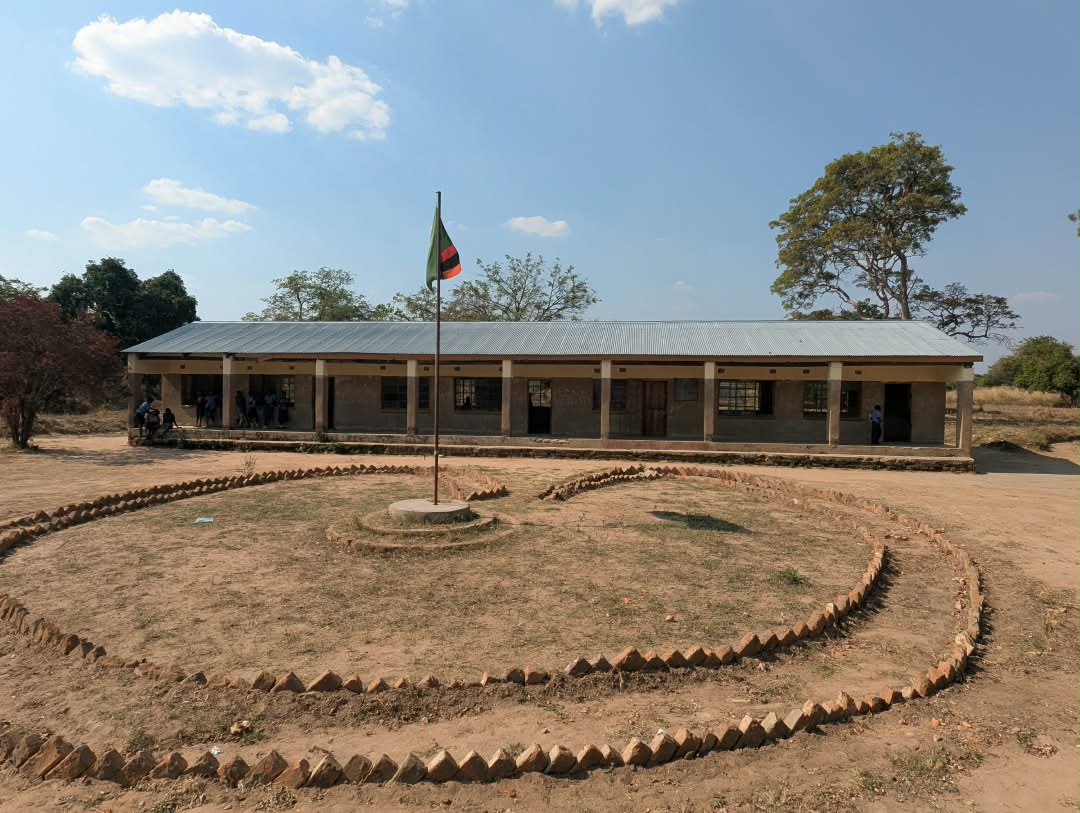
The Zambian national flag still flies high at Mwendachabe Primary School in Chiundaponde Chiefdom, Lavushimanda District which was the first school to be constructed in the area.
Mwendachabe School was constructed in 1911 by some white missionaries from Chilubula Mission in Kasama District, who came up with the idea of putting up a one by two classroom block in the area to be used in the training of catechists and church clerks to teach them how to read and write in English.
Before the construction of the classroom block at Mwendachabe, it is on record that the missionaries were conducting lessons under a big Kachele tree.
115 years later, the infrastructure at Mwendachabe Primary school still stands strong, – with just a few renovations done in the past. And unlike in the past, learners at the school are now able to sit on desks as they also enjoy the benefits of the free education policy introduced by the UPND administration.
Lavushimanda District, which has a population of about 55,755 people according to the 2022 census and covers 14,388 square kilometers, was for many years a remote part of the vast Mpika District until 2017 when it attained a District status; todate, the area has been benefiting from massive development in various sectors including the education sector.
Before independence in 1964, Lavushimanda had no government school. Education came with the Catholic White Fathers who established Mwendachabe Primary school in 1911, Chiundaponde Primary school in 1912 and Mpumba Primary school in 1937.
The other schools constructed before Independence in the area are Kapilya Primary in 1939, Lukulu Primary in 1946, Mabonga Primary in 1955 and Muwele Primary school constructed in 1958 while other schools came into being after independence.
Two traditional leaders, Chief Chiundaponde and Chief Mpumba allowed missionaries to open schools in these rural schools with a purpose of producing catechists and clerks who could read the Bible.
Redson Mwape, an early settler who is also a retired Head teacher, shares that parents in those days thought school was for lazy children who feared farming and that those interested in education could walk long distances of about 20 kilometers to school barefoot.
Mr Mwape recalls that speaking Ichibisa (BISA), the indigenous language for the area in class, was a punishable offence those days as pupils who spoke Bisa received strokes from their white teachers.
“We were just a small number and were taught to obey, such that anyone who spoke Ichibisa was punished. But now education is free for all and the number of learners, both girls and boys keeps increasing, this is Independence,” Mr Mwape said.
He also recalls that the area had no secondary school and when most boys, who continued their education from standard one to six and passed to reach secondary level, were taken to either Mpika Boys in Mpika or Kenneth Kaunda Technical School in Chinsali which is over 200 kilometers away.
Mr Mwape shares that it was after Zambia got independence in 1964 that few girls started showing interest in education, which was free under Kenneth Kaunda; though most of the girls only reached form two , while some were able to go for the Zambia National Service training and got employed.
“It was awkward to learn with girls in schools and most of them were quite old but fortunate enough to reach up to the level of ZNS training and get employed,” he said.
When Zambia got independence in 1964, President Kenneth Kaunda introduced free education. For Lavushimanda, which was called Mununga area of Mpika, this meant changing of the mission schools to government owned primary schools.
Even after independence in 1964, the education sector in Lavushimanda still faced challenges as the area had no secondary school. The first Secondary school to be established in the area was Mununga Day Secondary in 2013 followed by Chiundaponde Secondary established in 2014 while other secondary schools such as Salamo Day Secondary, Lukulu Day Secondary, Kalonje Day Secondary and Red Rhino Boarding Secondary came later in the recent past. Lavushimanda also has a World Bank funded Secondary School, Mwelushi Secondary currently being constructed under the Zambia Education Enhancement Project (ZEEP).
Today, Lavushimanda district boasts of having a total of 48 Schools , out of which 35 are Primary Schools, seven are Secondary schools with one Boarding school, four community schools and Two Private schools, with a total enrollment of 16, 500 learners.
Many of these schools are still very remote like Kamwendo Primary in the Luangwa Valley, about 400 kilometers from the district offices, and Muwele Primary in Chiundaponde situated over 200 kilometers from the Central Business District (CBD).
The biggest revolution in the education sector came after 2021 when President Hakainde Hichilema reintroduced free education and also increased the Constituency Development Fund (CDF).
Laushimanda District Education Board Secretary (DEBS) Beatus Nshenda says enrolment increased because parents were no longer required to pay user fees. The DEBS notes that most pupils are responding well to free education despite others still having to cover long distances to school.
The CDF has also helped to bridge the gap through construction of more schools in the area to meet the demand brought about by free education. Some of the schools constructed using CDF include a 1 by 2 new classroom block at Mwila Chilembwe Primary School, one by two classroom block at Makanga Primary School, one by two classroom block at Kalonje Primary School and a 1 by 2 classroom block at Salamo Primary School.
Lavushimanda Town Council has also completed the electrification of Mununga Day Secondary School and constructed a CDF girl’s dormitory for weekly boarders and a water reticulation system using the 2024 CDF. Learners at this school are now able to learn computers without any disruption as the school is also solar powered.
Red Rhino Boarding School in Mpumba Chiefdom is getting a new dormitory and ablution block under 2025 CDF while Chipelembe Community School and Milomfi Community School in Lukulu Ward each getting a 1×3 classroom block.
Others are Mwila Chilembwe Primary school which got a 1by2 classroom block with solar power and a water reticulation system under the 2024 CDF and there is also Mwelushi Day Secondary School in Chiundaponde Chiefdom, a World Bank funded school under ZEEP, which has created over 200 jobs for locals and will have 3 laboratories, becoming the first fully fledged boarding secondary school in the area.
Another 1 by 2 classroom block is under construction using the 2025 CDF and Mwenda Primary School in Mpumba Chiefdom.
In addition, the Government through the Rural Electrification Authority (REA) has electrified Kapengwe Primary School and Salamo Primary and Day Secondary Schools, meaning for the first time, learners from these schools can learn Information Communication Technology (ICT) even during night time.
Technology is also reaching the girls as the Ministry of Education has trained 25 guidance teachers in Lavushimanda and empowered them with tablets for digital verification under the Keeping Girls in School (KGS) program, ensuring that girls on bursary are not ghost learners.
The district is now benefiting from a number of policies being implemented by the Government such as the free education policy, school feeding program, KGS, CDF and the Campaign for Female Education (CAMFED) and all these programs are contributing to raising the standards for safeguarding the rights and welfare of children in school,
Lavushimanda, however, still needs more infrastructure in the education sector. Recently, District Education Standards Officer (DESO), Davy Mukuka, recently appealed for the establishment of seven more Secondary schools in the area and also the construction of more boarding secondary schools to cater for the growing population and also reduce on the long distances most learners cover to go to school
Teacher accommodation also remains a crisis especially in remote schools situated in Lulimala, Lupembashi and Mupamadzi wards which have deplorable state of houses with no waterborne toilets. In addition, the district currently has no skills training center, forcing children to go to Mpika and other districts for skills training, especially those of CDF bursaries.
Despite these challenges, the education sector in Lavushimanda has truly evolved through various government policies and leadership over the years.


Community Feedback