
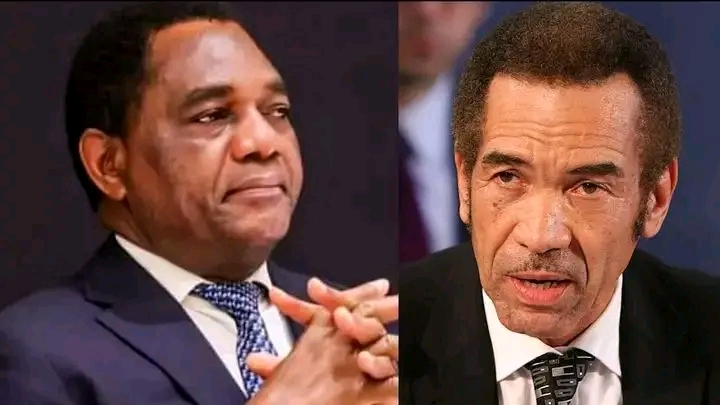
What is Driving Ian Khama’s Attacks on Zambia?

Breaking News Zambia
News🇿🇲 INSIGHT | What is Driving Ian Khama’s Attacks on Zambia? Why has former Botswana President Ian Khama suddenly become one of the loudest foreign critics of President Hakainde Hichilema? Since 2021, Zambia has witnessed arrests, prosecutions and fierce political disagreements under the UPND government. Khama did not mount a comparable public campaign during much […]
🇿🇲 INSIGHT | What is Driving Ian Khama’s Attacks on Zambia?
Why has former Botswana President Ian Khama suddenly become one of the loudest foreign critics of President Hakainde Hichilema? Since 2021, Zambia has witnessed arrests, prosecutions and fierce political disagreements under the UPND government. Khama did not mount a comparable public campaign during much of that period. He even travelled to Lusaka to meet Hichilema at State House. Following the August 2026 elections, however, his criticism has intensified, culminating in his description of the Zambian leader as “Africa’s newest dictator”.
What has changed?
In an interview published on Sunday, 1 November, Khama claimed that Hichilema had interfered with elections, detained political opponents and fabricated criminal charges. He further claimed that political activists had been kidnapped and tortured. These are serious accusations that require credible evidence. Former Vice-President Enock Kavindele has challenged Khama to substantiate his claims, while UPND Media Director Mark Simuuwe has rejected his description of Hichilema. Some opposition supporters, meanwhile, have welcomed his remarks. But a former presidential title does not give anyone unquestionable authority to pronounce judgement on another country’s democratic institutions.
We have followed Khama’s political relationships in Zambia, including his association with opposition politician Kelvin Kaunda, the founder of Eden University and Member of Parliament for Lima Constituency. Our reporting identifies commercial links between the two men, alongside plans to extend Eden University’s operations into Botswana and discussions about Khama becoming chancellor. Our investigations have also identified his involvement in mobilising campaign resources for Tonse Alliance ahead of the August elections. These relationships provide important political context for his sharp criticism and raise questions about the interests surrounding his growing involvement in Zambian affairs.
The timing is particularly striking. Since assuming office in August 2021, Hichilema’s government has pursued former ministers, senior public officials and other individuals accused of corruption, abuse of office and related offences. Supporters of the government regard these proceedings as necessary accountability measures, while opposition figures have questioned the impartiality of law enforcement. Khama did not publicly pursue a comparable campaign against Hichilema during those earlier controversies.
His strongest criticism has instead followed an election in which opposition figures associated with his political networks failed to secure power, with some subsequently facing criminal proceedings. The question is whether his present concerns reflect a consistent commitment to justice or a change in political circumstances.
There is also the question of regional consistency. Tanzania experienced deadly violence following its disputed 2025 elections, while Mozambique witnessed serious unrest and accusations of abuses against protesters following its own contested election. In eastern Democratic Republic of Congo, armed conflict involving M23 has brought killings, displacement and widespread suffering among civilians. Constitutional debates in Kinshasa have also raised concerns about presidential term limits.
The People’s Brief’s monitoring of Khama’s public engagements has not identified a comparable campaign by him concerning these crises. Why, then, has Zambia attracted such sustained criticism from a former leader who presents his arguments in the language of democracy and human rights?
Zambia’s history provides another perspective. During the conflict that ended Mobutu Sese Seko’s rule in 1997, thousands of Congolese fled into Zambia seeking safety. The country has repeatedly accommodated people escaping instability beyond its borders. Zambia has also experienced peaceful transfers of presidential power between competing political parties, including in 1991, 2011 and 2021. These achievements do not place any government beyond criticism, nor do they erase concerns about the treatment of political opponents. They do, however, challenge sweeping portrayals of Zambia as a country whose democratic institutions have collapsed. Its political history deserves greater respect than such descriptions suggest.
Khama’s own presidency, from 2008 to 2018, was not without controversy. Freedom House documented concerns about press freedom and the concentration of executive authority in Botswana. In September 2014, Sunday Standard editor Outsa Mokone was arrested and charged with sedition following reporting about an alleged road accident involving Khama. His government also faced criticism over restrictions affecting the rights of San/Basarwa communities.
These events do not prevent Khama from discussing democracy elsewhere, but they make his claim to moral authority open to examination. A former leader who questions another country’s democratic credentials should expect his own record to face similar scrutiny.
Diplomacy also matters. Botswana’s current leadership has maintained official relations with Zambia, including participation in Hichilema’s inauguration. When Khama questioned that attendance, Botswana’s foreign affairs minister defended the decision as an expression of good neighbourliness and an opportunity for engagement. This response reflects the importance of dialogue between neighbouring states.
Khama himself has previously met Hichilema at State House, demonstrating that communication is possible. If his concern is genuinely the welfare of detained opposition figures, established diplomatic relationships and lawful avenues of engagement offer alternatives to repeated public confrontation. His present approach may instead deepen political divisions and complicate efforts to address their circumstances.
For Zambians, this matter extends beyond Hichilema as an individual. The presidency is a constitutional institution whose authority comes from the people. Zambia’s democratic choices cannot simply be dismissed through sweeping accusations from a former foreign leader. Zambians have repeatedly demonstrated their ability to change governments through the ballot box, and they retain constitutional means of demanding accountability. Parliament, the courts, civil society and the media have responsibilities in that process. Regional bodies such as SADC also provide established channels for addressing matters of wider concern.
Respect for Zambia’s sovereignty should remain central to any discussion of its governance.
Ultimately, the questions surrounding Ian Khama are as much about his political relationships and the timing of his criticism as they are about the accusations he has made. The treatment of opposition figures deserves lawful scrutiny, and those facing criminal charges remain entitled to due process. Equally, Zambia’s institutions and its longstanding friendship with Botswana should not become casualties of personal or competing political interests.
Khama is entitled to express concerns about Zambia, but his claims, his record and his political associations must withstand the same scrutiny he demands of Hichilema. Zambians deserve an informed debate about their country’s future, not a diplomatic quarrel driven by accusations whose foundations remain contested.
The People’s Brief | Ollus R. Ndomu
2 November 2026


Community Feedback