
Zambia strengthens Ebola preparedness amid regional threat

Breaking News Zambia
NewsBy Salome Sakala As Ebola continues to pose a public health concern in the neighbouring Democratic Republic of Congo (DRC), the Ministry of Health, through the Zambia National Public Health Institute (ZNPHI), is strengthening the country’s preparedness to detect and respond to potential cases, with particular attention on border communities where the movement of people […]
By Salome Sakala
As Ebola continues to pose a public health concern in the neighbouring Democratic Republic of Congo (DRC), the Ministry of Health, through the Zambia National Public Health Institute (ZNPHI), is strengthening the country’s preparedness to detect and respond to potential cases, with particular attention on border communities where the movement of people can complicate disease surveillance.
In Milenge district in Luapula Province, the threat is particularly menacing because of the area’s proximity to the DRC, where communities maintain close social and economic ties across the border. The movement of people through porous crossing points presents a challenge for disease surveillance, making early detection, timely diagnosis and coordinated response essential in preventing the spread of infectious diseases.
The risk is compounded by insecurity in the DRC’s North Kivu, Ituri and South Kivu provinces, where people fleeing affected areas have made it difficult for health authorities to trace all contacts of infected individuals.
ZNPHI Acting Director General, Nyambe Sinyange, said contact tracing in the affected areas stands at 80 percent, leaving some people unaccounted for and potentially able to cross into neighbouring countries, including Zambia and Tanzania.
“It is currently at 80 percent, meaning that some people are not known in terms of where they are. Those are the same people that can cross over to Tanzania, the same people that can cross over to Zambia,” Dr Sinyange explained.
In such circumstances, an infectious disease can cross a border before authorities become aware of a potential case. This therefore reinforces the need for systems that can detect and investigate suspected infections without delay.
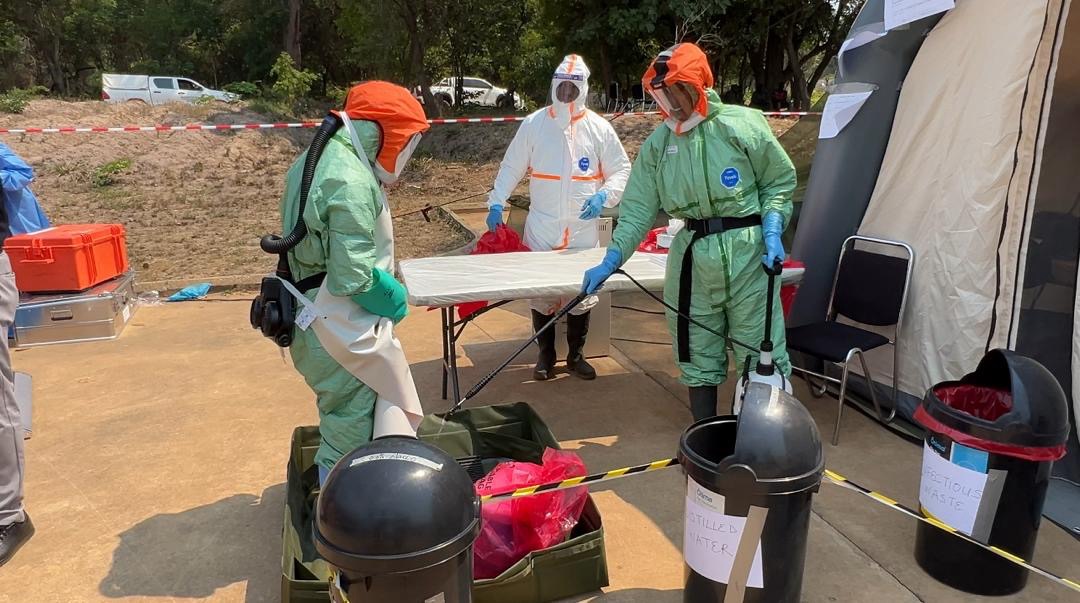
It is against this regional public health concern that a simulation exercise was conducted in Milenge to assess Zambia’s ability to detect, test for and respond to Ebola and other high-consequence infectious diseases before an actual emergency occurs. The exercise was also intended to establish whether the country’s response systems can function effectively under pressure.
At the centre of the exercise was a US$1.6 million biosafety level 3 mobile laboratory donated by the United States Government through the Department of War to strengthen Zambia’s capacity to respond to Ebola and other high-consequence infectious diseases.
Designed to bring specialised diagnostic services closer to remote and hard-to-reach communities, the laboratory provided an opportunity to assess the time required to transport the unit from Lusaka, the handling and testing of specimens, adherence to biosafety procedures and the timely communication of results to health personnel.
For Ministry of Health Director of Laboratory Services, Mweemba Muvwimi, the mobile facility addresses one of the challenges faced by communities located far from established diagnostic centres.
“Mobile laboratories are particularly important in remote and hard-to-reach areas where access to diagnostic services can otherwise be delayed,” Dr Muvwimi said.
However, the availability of specialised equipment alone does not guarantee an effective response. The laboratory must be deployed promptly, specimens handled correctly, safety procedures followed and results communicated to the relevant health teams in time to guide decisions.
The simulation therefore, provides an opportunity to assess these processes and identify areas that require improvement before a real emergency arises.
In Milenge, the exercise also carries local significance following an earlier suspected Ebola case in the district that subsequently tested negative. Although the result was reassuring, the incident demonstrated the importance of having the capacity to investigate suspected infections and provide timely information to guide public health decisions.
Milenge District Commissioner, Kayula Mulenga, said the experience reinforces the need for accessible diagnostic services and adequate infrastructure to support health personnel responding to potential public health threats.
Mr Mulenga has meanwhile appealed for an establishment of a permanent facility that could provide a suitable working environment for laboratory operations and support health services in Milenge and the wider province.
Beyond the equipment and technical procedures, the exercise demonstrates the importance of coordination among health authorities, security agencies, disaster management institutions and international partners.
Effective outbreak response depends on these institutions working together to ensure that suspected cases are identified, specimens are safely managed and the necessary response measures are activated without unnecessary delays.
United States Department of War representative, Matt Yan, describes the exercise as part of a longstanding health partnership between Zambia and the United States.
“This exercise is just another important milestone out of the 25 years of U.S.-Zambia cooperation in the health sector,” Lieutenant Colonel Yan says.
The partnership has included support for Ebola response efforts, with the United States providing over US$887 million in direct assistance for the disease and an additional US$267 million for the response in the DRC. The mobile infectious disease laboratory, valued at US$1.6 million, further demonstrates the role of specialised technology and inter-agency cooperation in strengthening emergency response capacity.
At provincial level, Luapula Province Health Director, Simon Kunda, views the simulation as an opportunity to establish whether the systems, personnel and equipment available can effectively work together when confronted with a real threat.
“Finding and correcting gaps now I think is the very purpose of the simulation that we are doing today,” Dr Kunda said.
The lessons from the exercise are expected to inform preparedness planning, staff training and resource allocation, while reinforcing the need to protect health workers, patients and surrounding communities.
Dr Kunda has also clarified that the activity is a planned simulation and should not be interpreted as an announcement of an Ebola outbreak in Milenge.
For communities far from established laboratories, the ability to investigate suspected cases and obtain reliable results quickly can make a difference in how health authorities respond. Timely diagnosis supports informed decisions on isolation, treatment and other measures needed to contain a potential outbreak.
Ultimately, the value of preparedness lies not merely in having specialised equipment, but in ensuring that the people and systems responsible for using it are ready when an emergency occurs. Dr Sinyange says, “As we prepare for outbreaks, we must always remember that we must prepare before the threat arrives, we must detect before it spreads, and we must respond before lives are lost.”
As Zambia continues to strengthen its public health preparedness, the Milenge exercise illustrates the importance of acting before a threat becomes an emergency.
In a region where people and communities are closely connected across national borders, sustained surveillance, accessible diagnostic services and cooperation among local, national and international partners remain essential to protecting lives.



Community Feedback