
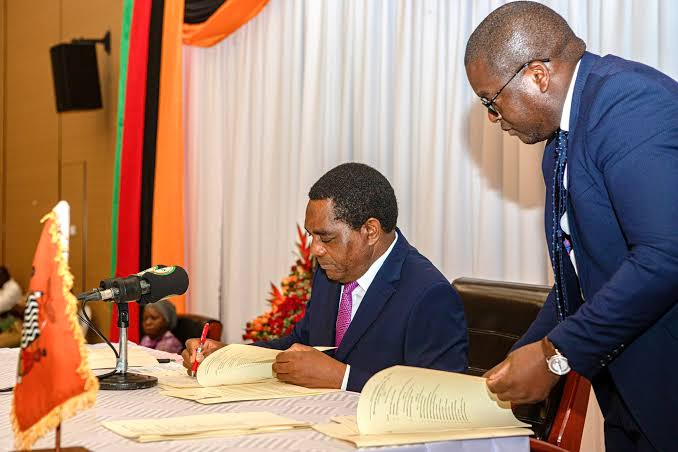
Zambia implements only one of 22 EU election reform recommendations made in 2021

Breaking News Zambia
NewsThe European Union Election Observation Mission (EU […]
The European Union Election Observation Mission (EU EOM) to Zambia has reported that the Zambian government has implemented just one out of 22 election reform recommendations issued following the country’s 2021 general elections. The update comes after the 13 August 2026 general polls, with the EU EOM expressing concern over the lack of substantial progress on critical reforms.
The EU EOM’s 2021 Final Report outlined 22 recommendations, including six urgent priorities, aimed at enhancing the transparency, fairness, and inclusivity of Zambia’s electoral process. In its 2024 follow-up mission, the EU observed limited advancement, underscoring that all original recommendations remain pressing and relevant.
According to the latest official report, of the 22 recommendations, only the enactment of an Access to Information law has been fully implemented. “While a recommendation to decriminalize defamation of the president was technically adopted, the intended impact was undermined by similar provisions in other legislation, such as the Cyber Crimes and Cyber Security Acts.”
Six priority recommendations, ranging from new political party laws, comprehensive campaign finance reforms, and fairer candidacy requirements, to removing undue campaign privileges for incumbents and formalizing cooperation on countering harmful online activities, remain unaddressed. Though the National Assembly passed a Public Gathering Bill, the restrictive Public Order Act continues to govern assembly and movement during elections.
Meanwhile, the EU EOM reported that partial implementation was noted in four areas, such as improved voter education, revised polling rescheduling procedures, expanded polling premises, and new but inactive laws affecting state media. “Ten recommendations saw no action, including calls for greater decentralization of the Electoral Commission of Zambia (ECZ), transparent boundary delimitation, fairer political advertising limits, and more inclusive accreditation procedures for observers and media.”
The EU EOM also highlighted long-standing recommendations, repeated in its reports since 2001, such as ensuring a level playing field for all candidates, repealing the Public Order Act, enacting effective political finance laws, and transforming the Zambia National Broadcasting Corporation (ZNBC) into a genuine public service broadcaster. Efforts to promote equal participation for women and transparent election processes also remain unmet.
The EU EOM concluded that the lack of progress on these reforms continues to affect the overall credibility and inclusivity of Zambia’s electoral process.




Community Feedback