
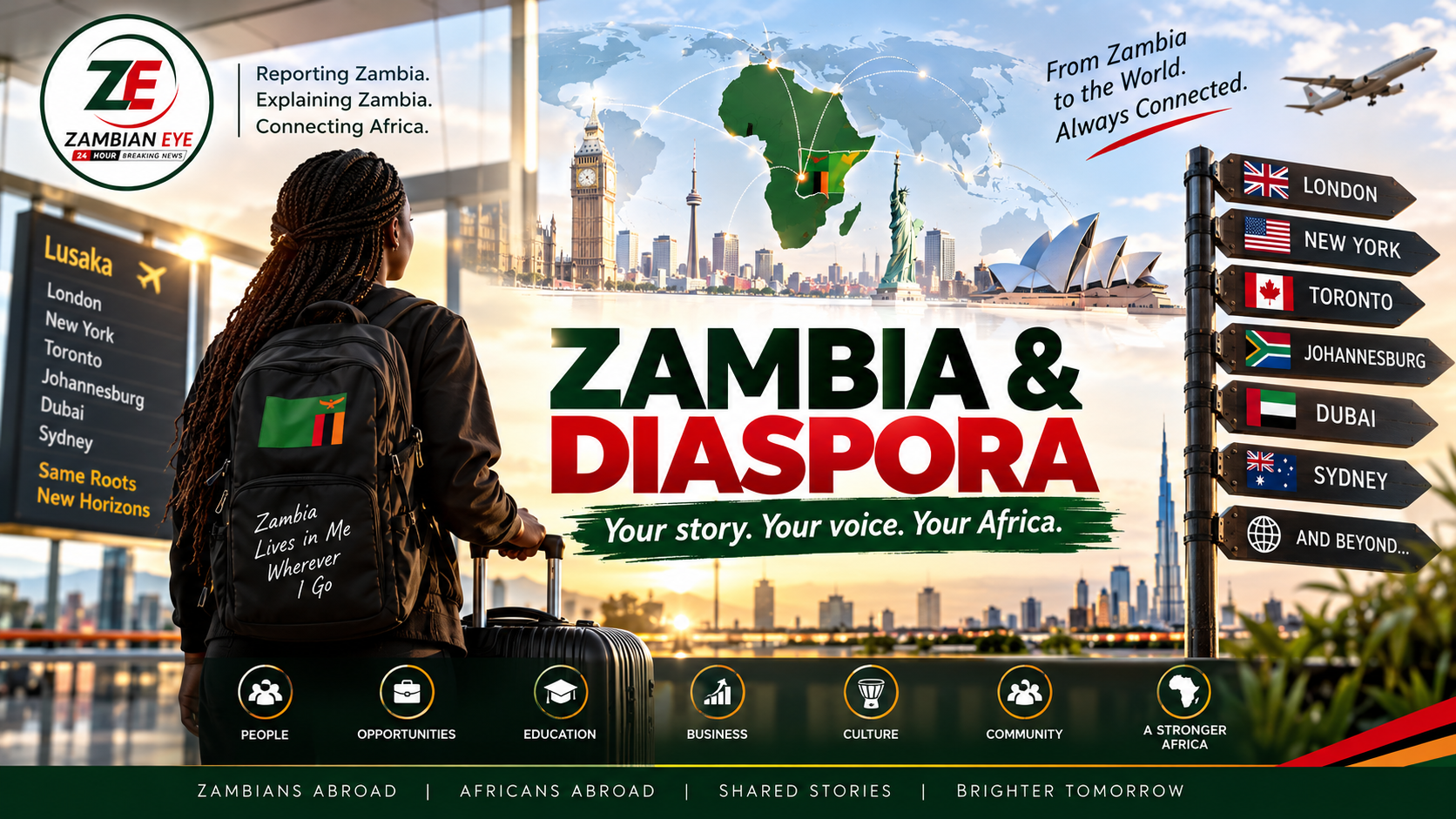
Why Are Zambians Leaving — And What Makes Them Return?

Breaking News Zambia
NewsLeaving Zambia is rarely the result of a single decision. For one person, it begins with a university admission letter. For another, it is a job offer. For someone else, it may be the search for a better income, professional growth, a business opportunity or the chance to join family members who have already established […]
Leaving Zambia is rarely the result of a single decision.
For one person, it begins with a university admission letter.
For another, it is a job offer.
For someone else, it may be the search for a better income, professional growth, a business opportunity or the chance to join family members who have already established themselves abroad.
And for some, leaving is simply a response to opportunities that are difficult to find at home.
But there is another side to the story that is often overlooked.
What makes a Zambian want to come back?
That question may become increasingly important as Zambia’s Diaspora grows and as more Zambians build careers, families and businesses outside the country.
Because leaving Zambia does not necessarily mean leaving Zambia behind.
A country on the move
Migration is not unique to Zambia.
People move across borders for employment, education, family, business, security and other reasons. The World Bank notes that migration is often shaped by differences in income and opportunity, demographic pressures, social networks and policy choices in both origin and destination countries.
For Zambia, the Government has recognised labour migration as an issue with both opportunities and challenges.
The National Labour Migration Strategy 2024–2028 notes that Zambia has a large youthful population and that limited economic and employment opportunities contribute to the conditions that can encourage labour migration.
The strategy cites data showing that in 2022 more than 100,000 applicants competed for recruitment drives involving 11,000 health workers and 30,000 teachers.
For a young graduate looking at those numbers, the decision to look beyond Zambia’s borders can become understandable.
Education is often the first step
For thousands of Zambians, migration begins with education.
A student leaves Zambia for South Africa, the United Kingdom, the United States, Australia, Canada or another country to pursue a degree that may not be available locally—or to gain access to a particular institution, programme or research opportunity.
But graduation creates another decision.
Do I come home?
Some do.
Others receive employment offers and remain in the country where they studied.
A graduate may also find that their qualification opens doors to a professional market where there is greater demand for their particular skills.
What begins as educational migration can therefore become permanent or long-term employment migration.
The decision is not always ideological.
Sometimes it is simply practical.
Work and professional opportunity
Employment remains one of the most important considerations in migration.
A trained professional may look abroad because the international market offers opportunities to specialise, earn more, work with advanced systems or progress more quickly in their profession.
This can be particularly significant for highly skilled Zambians.
Doctors, nurses, engineers, academics, accountants, ICT specialists and other professionals may find demand for their skills in other countries.
That creates a complicated situation for Zambia.
The country can lose skills when professionals leave.
But those same professionals can gain international experience, build networks and acquire knowledge that can eventually benefit Zambia.
The World Bank’s research on migration recognises both sides of this equation: origin countries can gain from remittances and knowledge transfers, but the absence of skilled workers can also contribute to brain drain.
The challenge is therefore not simply to stop people from leaving.
It is to create pathways through which migration can also produce benefits for the country they left.
Business can be another reason to leave
Migration is not only about employment.
Some Zambians leave because they see opportunities to establish businesses abroad.
Others leave first and discover entrepreneurship later.
A Zambian who begins working overseas may develop an international network, learn a new business environment and eventually build a company that operates across borders.
That can create another form of connection with Zambia.
The business may import products.
It may employ Zambians.
It may invest in Zambia.
Or it may eventually establish operations at home.
In that sense, migration can sometimes create an economic bridge rather than simply a permanent separation.
Family is part of the story
Not every Zambian abroad left because of a career.
Family plays an equally important role.
Someone may move to join a spouse.
A parent may relocate to be with children.
A young person may follow relatives who migrated earlier.
A marriage may create a new connection to another country.
And once a family becomes established abroad, returning becomes more complicated.
A person may want to come home, but their spouse may have a career elsewhere.
Their children may have been born abroad.
The children may speak another language more comfortably.
They may be accustomed to another education system.
They may have built their friendships and social lives outside Zambia.
The question then changes from:
“Do I want to return?”
to:
“Can my whole family return?”
Then comes the question of home
For someone who has lived abroad for five, ten or twenty years, Zambia can become both familiar and unfamiliar.
The person returning may remember Zambia as it was when they left.
But the Zambia they return to may have changed.
Their own expectations may also have changed.
They may have become accustomed to different systems, standards of service, working environments and professional cultures.
This can make returning an adjustment in itself.
Coming home is therefore not always a simple reversal of migration.
It can be another migration experience.
The surprising willingness to return
This is where one of the most interesting findings from Zambia’s Diaspora research comes in.
An IOM-supported Zambian Diaspora Mapping and Profiling Survey, published in 2023, found that 93.1% of 682 respondents said they would be interested in returning to Zambia temporarily to work or practise their profession if an opportunity for skills transfer was available.
That finding deserves attention.
It suggests that being abroad does not necessarily mean a Zambian has lost interest in contributing at home.
In fact, many may be willing to return—at least temporarily—if there are credible opportunities to use their skills.
Among the respondents, the professions represented included healthcare, business and finance, education, management, engineering, computer science and other fields.
The survey therefore points towards an important possibility:
Perhaps the question is not always how to bring everyone home permanently, but how to make it easier for people abroad to contribute from wherever they are.
What would make people return?
There is no single answer.
For some, it could be a good job.
For another person, it could be a viable business opportunity.
For a professional, it might be access to equipment, research facilities or an institution where their expertise is needed.
For a parent, it might be the desire to raise children in Zambia.
For someone approaching retirement, it could be the wish to spend their later years at home.
For an entrepreneur, it could be access to capital and a predictable business environment.
And for another Zambian, the motivation may simply be emotional.
Home.
Returning does not always mean giving everything up
There is also a growing possibility of something between staying abroad and returning permanently.
A doctor can spend several weeks in Zambia providing specialist training.
An academic can teach a short course or collaborate with a Zambian university.
An engineer can advise a local company remotely and visit periodically.
An entrepreneur can establish a Zambian operation while continuing to live overseas.
An ICT specialist can mentor young Zambian professionals online.
The IOM survey found particularly strong interest in temporary skills-transfer opportunities, while Zambia’s Diaspora Policy explicitly identifies knowledge and skills transfer as an area for Diaspora engagement.
This is where the idea of circular migration becomes important.
A Zambian does not necessarily have to choose between being “abroad” and being “home”.
They can, in different ways, be connected to both.
What Zambia can do
The Government has already recognised that relationship.
Zambia’s National Diaspora Policy was launched in 2019 with the objective of creating a framework for active participation by Zambians abroad in the country’s socio-economic development.
Its priorities include Diaspora investment, knowledge and skills transfer, financial resources, technology, citizenship and engagement.
The Government has also described the Diaspora as a partner in development and has established a Diaspora Portal to provide information on policies, procedures, investment and trade opportunities and other initiatives.
But policy is only one part of the equation.
The practical experience matters.
If someone abroad wants to return, can they easily understand the procedures?
Can they transfer professional qualifications?
Can they establish a business?
Can they find reliable partners?
Can they access information about opportunities?
Can they bring their children into the education system?
Can they obtain the necessary documentation?
Can they find meaningful employment?
The easier those questions become to answer, the easier it may become for the Diaspora to participate.
The generation that may return differently
There is another emerging question.
What happens to Zambians who were born abroad?
Their relationship with Zambia may be different from that of someone who personally left Lusaka, Kitwe, Ndola, Livingstone or another Zambian town.
For them, Zambia may be their parents’ home.
It may be the country of their grandparents.
It may be the place they visit during school holidays.
It may be a country they know through family stories, food, music and culture.
Some may eventually choose to study or work in Zambia.
Others may never live there permanently.
But the connection can still matter.
That makes Diaspora engagement not simply a migration issue.
It is also an issue of identity and belonging.
So, why do Zambians leave?
The answer is as diverse as the people themselves.
They leave for:
Education.
Employment.
Professional development.
Business.
Family.
Better opportunities.
International experience.
Personal aspirations.
And sometimes because they believe another country can offer something they cannot currently find at home.
But that is only half the story.
Many continue to send money home.
Many maintain businesses and property in Zambia.
Many remain connected to family.
Many follow Zambian affairs closely.
And, according to the IOM survey, many are willing to return temporarily if there are meaningful opportunities to transfer their skills.
Maybe the better question is not “Why did they leave?”
For Zambia, the long-term question may be more constructive:
How do we keep the connection alive?
Because not every successful Zambian abroad will return permanently.
Nor should every person be expected to.
A Zambian who builds a successful career in Johannesburg, London, New York, Dubai or elsewhere can still contribute to Zambia.
They can invest.
They can mentor.
They can teach.
They can collaborate.
They can create jobs.
They can open markets.
They can send money.
They can return temporarily.
And one day, they may decide to come home.
The goal, therefore, should not necessarily be to treat migration as a one-way departure.
It can be a relationship that continues across borders.
Coming home can take many forms
For one Zambian, coming home may mean moving back permanently.
For another, it may mean opening a business.
For someone else, it may mean spending three months teaching at a university.
For another, it may mean returning every year to support a community project.
And for someone born abroad, it may simply mean deciding to learn more about the country their parents call home.
All of these are different forms of connection.
And all of them form part of the larger Zambia & Diaspora story.
Because leaving Zambia does not always mean leaving Zambia behind.
Sometimes, it means carrying Zambia with you—and finding new ways to remain connected to home.
Zambia & Diaspora — connecting Zambia with its people wherever they are in the world.

Community Feedback