
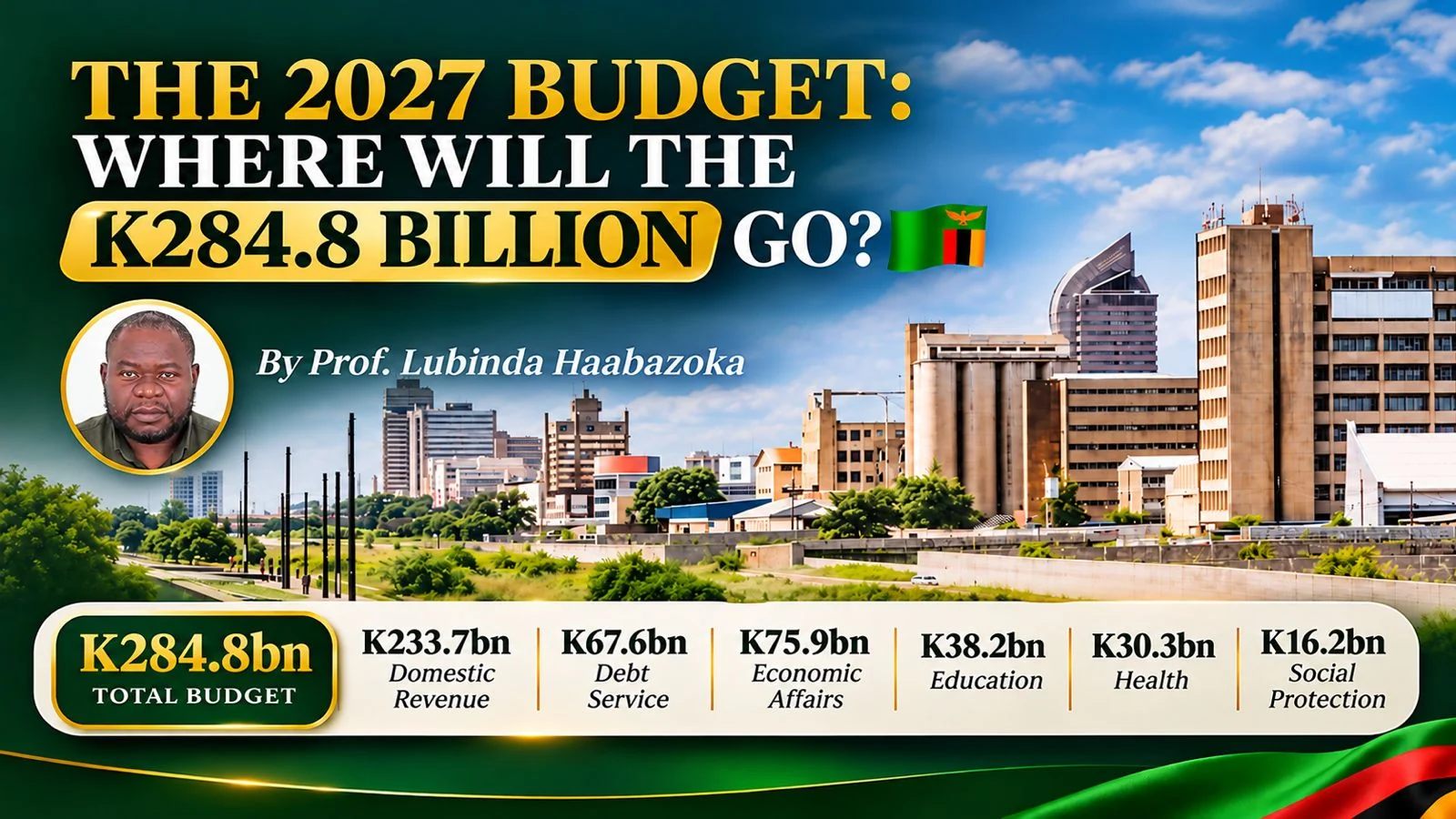
THE 2027 BUDGET: Where will the K284.8 BILLION Go? 🇿🇲 By Prof. Lubinda Haabazoka

Breaking News Zambia
NewsA national budget must eventually mean something at the kitchen table: food, jobs, affordable transport, medicines and a decent school for our children. So, what does Zambia’s proposed K284.8 billion budget for 2027 offer? One encouraging development is how much Zambia expects to raise itself. Domestic revenue will finance K233.7 billion, or 82.1% of expenditure,
Audio article Listen to this story Share Send this storyA national budget must eventually mean something at the kitchen table: food, jobs, affordable transport, medicines and a decent school for our children. So, what does Zambia’s proposed K284.8 billion budget for 2027 offer?
One encouraging development is how much Zambia expects to raise itself. Domestic revenue will finance K233.7 billion, or 82.1% of expenditure, compared with 58.7% in 2021 and 76% in 2024.
Include K28.9 billion in domestic borrowing, and 92.2% of financing comes from domestic sources. Foreign loans contribute approximately K13 billion, while grants provide K9.2 billion.
That is substantial progress towards self-reliance. But borrowing must be repaid, so 82.1% financed through domestic revenue remains the stronger measure of independence.
Where will the money go?
Debt still takes a substantial bite. Of the K90.5 billion for general public services, K67.6 billion goes to debt service: K50.8 billion domestically and K16.8 billion externally. That is K23.70 from every K100 budgeted, nearly matching the combined K68.5 billion for education and health.
Another K4.7 billion will clear arrears. For suppliers and contractors awaiting payment, this could mean wages paid, loans settled and businesses moving again. Digitalisation receives K1.7 billion, while K1.5 billion supports the Local Government Equalisation Fund.
Production gets a major push. Economic affairs receive K75.9 billion, including K22.7 billion for agriculture, fisheries and livestock. Within this are K9.1 billion for farmer input support, K822.5 million for animal health and K100 million for beef compartments supporting export access.
The proposed transition towards an agricultural loan scheme is expected to start in 2027. Irrigation, mechanisation and farm blocks will support production, while fish output is targeted at 300,000 tonnes. The challenge is connecting farmers to buyers, storage, processing and transport.
Roads receive K18.1 billion, with work proposed on 787 kilometres. Named routes include Kazungula–Sesheke, Kisasa–Mwinilunga, Chipata–Lundazi, Chipata–Chadiza, Nchelenge–Kaputa and the Mufumbwe–Kabompo corridor.
Rail plans include TAZARA rehabilitation, a Kapiri Mposhi dry port, and Lobito railway construction expected to begin in the fourth quarter of 2027. An initial €60 million has been secured for the Kapiri Mposhi–Ndola railway section.
Airports receive K2.35 billion. Mansa and Mfuwe are scheduled for completion, Nakonde construction continues, and works are planned for Choma, Chipata, Mongu and Solwezi. Tourism programmes receive K1.36 billion.
Electricity is central to making these investments productive. More than 1,400MW of additional non-hydropower capacity is expected in 2027, alongside K391.3 million for grid resilience. Transmission upgrades and proposed petroleum pipeline investments should strengthen energy security, although these wider projects have financing arrangements beyond annual Treasury spending.
Mining opportunities include expansions at First Quantum Minerals, Barrick Lumwana, KCM and Mopani, rehabilitation at Kalengwa and Luanshya, and development of Kitumba and KoBold’s project. These are investment opportunities; the speech does not guarantee that all will open in 2027.
Mining programmes receive K1.21 billion. Business financing measures include K400 million for a new development finance institution, K507.3 million for PPP support, and a separate K5 billion Bank of Zambia small-business guarantee scheme.
Education receives K38.2 billion. This includes K3.17 billion for infrastructure, K2.76 billion for school operations, K1.95 billion for student loans and scholarships, and K1 billion for school feeding, up from K523 million.
Plans include completing 31 secondary schools, beginning six new universities, and expanding skills training capacity by 100,000 places starting in 2027.
Health receives K30.3 billion, including K6.4 billion for medicines, K866.7 million for district and mini-hospitals, and K360 million for health insurance. Priorities include cancer facilities in Ndola and Livingstone, the King Salman hospital in Lusaka, and recruitment of 3,125 frontline medical personnel.
Housing and community amenities receive K4.63 billion, including K2.08 billion for water and sanitation.
CDF rises to K9.05 billion from approximately K6.2 billion, while remaining K40 million per constituency. The larger total accommodates more constituencies, with emphasis on completing existing projects.
Social protection receives K16.2 billion. Of this, K10.36 billion supports cash transfers for over 1.6 million households. Standard monthly payments would rise from K400 to K450, and from K600 to K650 for households with eligible persons with disabilities. Another K5.25 billion supports public service pensions.
Defence receives K14.65 billion, public order and safety K11.36 billion, environmental protection K2.29 billion, and recreation, culture and religion K736.3 million.
The direction is encouraging: more domestic financing, investment in production and continued social support. Now every allocation must earn its place through results.
For the ordinary Zambian, success will be measured in a completed road, medicines at the clinic, reliable power, a paid pension and a job that puts food on the table.
Your reaction
Have your say
Everyone is welcome. No account or email needed.
Comments 0
Be the first to start the conversation.
Community Feedback