
Lifeline closer to home

Breaking News Zambia
NewsBy Abigail Kashweka Salome Namwaba thought she was dying. Seven months pregnant and in perfect health, she woke up from her sleep to ease herself, only to realize she was bleeding with clots. “I woke up my husband and arrangements were made to take me to seek medical attention. When we got to Kanyanga Mission […]
By Abigail Kashweka
Salome Namwaba thought she was dying. Seven months pregnant and in perfect health, she woke up from her sleep to ease herself, only to realize she was bleeding with clots.
“I woke up my husband and arrangements were made to take me to seek medical attention. When we got to Kanyanga Mission Health Centre, I was referred to Chasefu mini-hospital,” she narrated.
The bleeding continued until she lost consciousness.
“I did not think my child and I would be alive today. But the quick intervention at the mini hospital saved my life, and most importantly, my child’s life,” she said as she emotionally recounted her experience.
Before February 2026, mothers finding themselves in Salome’s terrifying situation would have risked covering over 44 kilometers to Lundazi to access life-saving services, a distance sometimes even longer depending on one’s location.
“If it was back then when we relied on Lundazi for operative deliveries, I maybe could have died or lost my child, looking at the distance and bad road,” she added.
Today, her child Maureen is a healthy 7-month-old, having grown from a birth weight of 1.5 kilograms to 7.3 kilograms.
“Each time I look at her, I am reminded of the grace of God and the dedication of the staff who attended to me,” Salome said.
Salome’s survival is a direct testament to the critical upgrade of Chasefu mini-hospital into a Comprehensive Emergency Obstetric and Newborn Care (CEmONC) site.
Dr Aaron Mwango, who served as the Chasefu District Director of Health Services before moving to Lundazi, vividly recalls treating Salome when she arrived in shock just after the CEmONC site opened.
“Luckily at the time, Chasefu was a CEmONC site. We provided the necessary and managed to serve both the mother and daughter,” Dr. Mwango explained.
“We successfully extracted a premature baby, weighing 1.5 kilograms. The child was nursed in the Neonatal Intensive Care Unit for about a week until it gained some more weight. This is a child who is alive today and very healthy.”
By August 2026, the facility recorded 273 caesarean section deliveries without a single poor maternity outcome.
Dr Chota Phiri, a Consultant Obstetrician at Lundazi District Hospital, noted that Chasefu previously contributed 50 percent of all maternal deaths recorded in Lundazi.
“If we had 10 deaths recorded in that particular year, then you find five were patients referred from Chasefu,” Dr Phiri explained.
In 2025 alone, before the CEmONC facility was established, Chasefu made about 1,000 referrals to Lundazi, including 12 cases of ruptured uteruses that sometimes ended in death.
Today, only complex cases like antepartum haemorrhage are referred to Lundazi.
Eastern Province records high numbers of deliveries, second only to the capital, Lusaka, which has heightened the demand for maternal services.
According to Dr Mbinga Mbinga, the Senior Medical Superintendent at Chipata Central Hospital, the province recorded close to 23,000 deliveries in the first quarter of 2026 alone compared to Lusaka, that stood at 25, 000.
For this reason, and to ensure universal health coverage, the province partnered with Family Health and Nutrition (FHN) – a United States Department of State-funded program, to improve maternal health outcomes.
The FHN Project is a health consortium operating in Zambia, led by International Health Organization (Jhpiego) in partnership with the Churches Health Association of Zambia (CHAZ) and the Ministry of Health (MOH).
Rather than creating parallel systems, FHN works through existing Ministry structures to provide technical assistance, strengthen health worker knowledge and skills, conduct mentorship, and improve data-driven decision-making.
Introduced in 2021, the program has been working toward the ambitious national target of reducing maternal deaths from 278 per 100,000 live births around 2018 to less than 100 per 100,000.
In Eastern province, the MoH, in collaboration with FHN, operationalized three CEmONC sites by September 2026; including Chasefu Mini-Hospital in Chasefu district, Vubwi District Hospital and Muzeyi Mission Rural Health Centre in Chipangali.
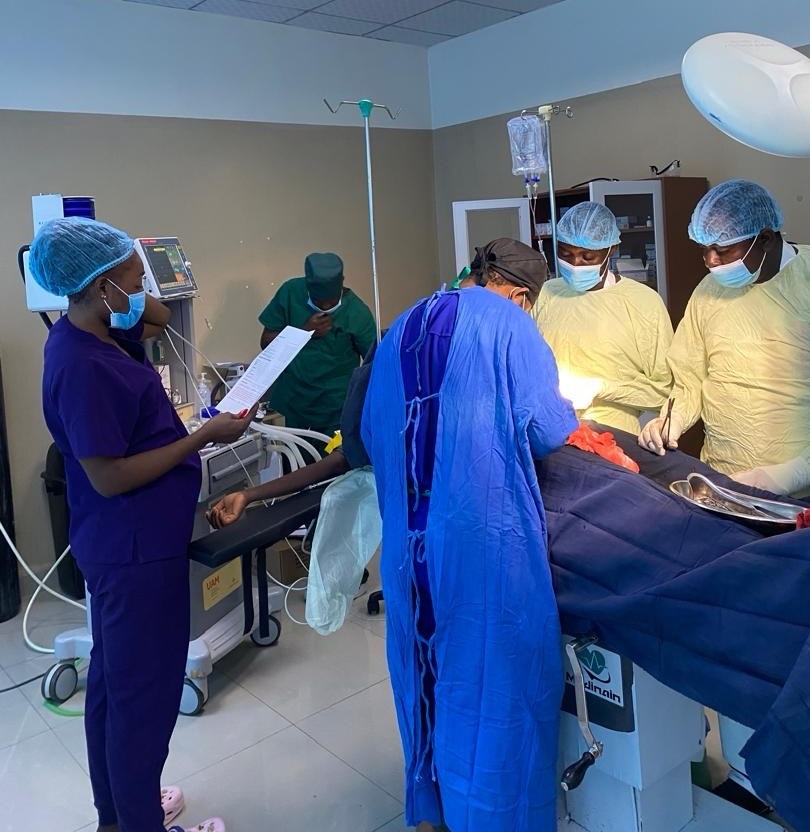
CEmONC facilities provide 24/7 life-saving medical and surgical interventions, including caesarean sections, safe blood transfusions and advanced neonatal resuscitation.
At Chipata Central Hospital, a Level 3 provincial referral hospital providing healthcare delivery, teaching and research, Dr Mbinga highlights the profound relief these sites have brought.
The hospital records between 170 and 200 deliveries a week, with roughly 40% via caesarean section.
He notes that about 70% of cases handled at Chipata could be managed at district facilities if upgraded, emphasizing the need for more interventions and collaborations in the area.
Authorities at Muzeyi Mission Rural Health Centre in Chipangali District, which opened its theatre in October 2025, say up to 330 Caesarean sections have been performed at the facility.
Registered Nurse Midwife Linda Simalyata notes that training through FHN in Helping Babies and Mothers Survive (HMS) and advanced neonatal resuscitation has equipped staff to handle severe complications like eclampsia and Postpartum Haemorrhage (PPH) locally.
She said the collaboration with FHN has helped the facility.
“In cases where we have a complication such as eclampsia or severe birth asphyxia, and any other complication, we are able to note the complications and manage the cases accordingly to prevent morbidity and mortality to both the mother and the baby,” she said.
Additionally, Dr Rajab Tembo, the Medical Officer-in-Charge states that Muzeyi receives a lot of obstetric emergencies, due to the increased numbers of teenage pregnancies.
Chipangali district is one of province’s leading districts in teenage pregnancies.
In the first quarter of last year, 57 school-going teenagers were reported to have fallen pregnant while a total of 232 fell pregnant in 2024.
“So, because of that, we experience a lot of complications. Now, after the introduction of theatre and other activities by FHN and the Ministry of Health, we have seen a drop in the number of referrals that go to Chipata Central Hospital. For instance, in the third quarter of 2026, we only made 19 referrals and we have had about 438 deliveries with 84 caesarean sections,” Dr Tembo elaborated.
Similarly, Vubwi District Hospital, a border rural area, has seen remarkable success, extending life-saving care to local residents and cross border clients alike. Among them is Patience Banda, a Malawian national who travelled to Vubwi to visit her sister.
Falling severely ill during her stay, she was admitted for nearly a week due to high blood pressure.
On the seventh day, after realising that her baby was not kicking normally, comprehensive examinations prompted the medical team to advise an immediate operation.
“I was scared, but the fear went away. People here treated me well without segregating that I am not Zambian,” Patience recounted.
She had her baby at 35 weeks due to pregnancy-induced hypertension.
Dr Chisoni Sakala, the Vubwi District Hospital Medical Officer in Charge, noted that the caesarean section delivery was performed within one hour of diagnosis.
“With the availability of the theatre, we conducted the operation within one hour of diagnosis. It took about 50 minutes,” he indicated.
He said the intervention successfully averted a potential tragedy, noting that prior to the theatre’s operationalization, such cases had to be transported to Chipata nearly 60 kilometers away across challenging terrain.
“The district has managed to cut on maternal referrals to Chipata from about 80 in the second quarter of this year, to less than 20 in the third quarter,” Dr Sakala indicated.
Vubwi is also closely working with the Safe Motherhood Action Group (SMAG) to reach out to communities in encouraging seeking maternal care at health facilities. Donasiana Sakala, who operates from Chikoma Rural Health Centre as a SMAG member, says most people in her area are enlightened and are now able to go to facilities to seek comprehensive maternal health care.
“Some women were initially frightened due to misinformation and perceived surgical risks. But witnessing their peers undergo successful caesarean sections completely transformed public perception,” she said.
Today, women in Chipangali freely access these crucial services, eliminating the financial burdens of long-distance travel and extended stays at mothers’ shelters in Chipata.
As the FHN program phases out in December 2026, its profound legacy remains anchored in institutionalized capacities, locally trained medical personnel, and decentralized CEmONC facilities that continue to safeguard mothers and newborns across Zambia’s Eastern Province.





Community Feedback