

Jacob Zuma Appoints Daughter Thuthukile to Senior MK Party Position

Breaking News Zambia
Newsacob Zuma has appointed his daughter Thuthukile as MK Party Acting Deputy Secretary-General, adding to questions about family influence and leadership in South Africa's third-largest party.
… Zuma is President and his Son is the First Deputy PresidentThe leadership of South Africa’s third-largest political party, uMkhonto weSizwe (MK), is facing fresh scrutiny following a series of developments that have placed members of former President Jacob Zuma’s family at the centre of its political and organisational affairs.
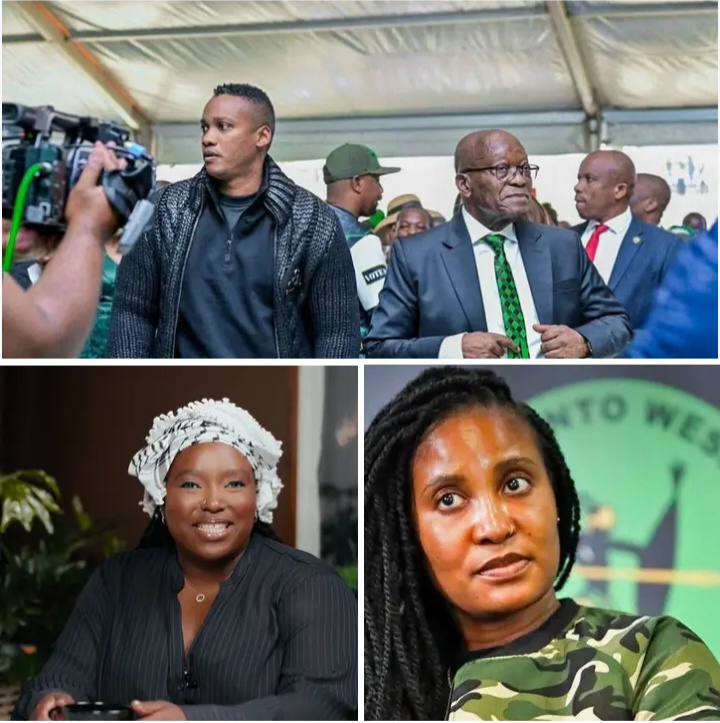
The latest development is Jacob Zuma’s appointment of his daughter, Thuthukile Zuma, as the party’s Acting Deputy Secretary-General, while also directing that she be deployed to the National Assembly as a Member of Parliament.
In a media statement dated November 27, 2026, the party announced that the appointment takes immediate effect.
The statement described Thuthukile as an experienced political activist with a longstanding record of involvement in progressive politics and organisational leadership.
It said her deployment to Parliament was intended to strengthen the MK Party’s parliamentary caucus.
The announcement also confirmed that Sifiso Mahlangu’s appointment as National Spokesperson had been reaffirmed, with responsibility for the party’s media, public relations and strategic messaging.
Meanwhile, Lindiwe Mtshali will continue serving as the party’s Acting Secretary-General.
Another Zuma joins the party’s top leadership
Thuthukile’s appointment comes against the background of her recent departure from the African National Congress (ANC), where she served on the Johannesburg regional executive committee.
She resigned from the regional structure on November 10, 2026, after facing possible disciplinary action over allegations relating to absenteeism and her participation in party activities.
The appointment has attracted attention because of her family connection to the party president and the timing of her move from the ANC to the MK Party.
She now joins her brother, Duduzane Zuma, who was appointed First Deputy President of the MK Party in August 2026.
With Jacob Zuma serving as party president, the appointments place two of his children in senior positions within the organisation.
Duduzile’s return after court ruling
The developments also follow a significant court ruling involving another of Jacob Zuma’s daughters, Duduzile Zuma-Sambudla.
On November 25, the Gauteng High Court in Johannesburg set aside her expulsion from the MK Party, together with that of former party spokesperson Nhlamulo Ndhlela.
The court found that the party had failed to establish that valid presidential decrees authorising their expulsions existed and had not followed its own disciplinary procedures.
Duduzile had not been subjected to disciplinary proceedings before her expulsion was announced.
The court did not determine whether the allegations of misconduct against the two were true. Instead, it ruled that the party was required to follow its constitution and provide members with procedural fairness.
The ruling restored their membership and membership rights.
Duduzile had previously resigned from Parliament amid controversy surrounding allegations that South African men had been recruited to fight for Russia in the war in Ukraine. She was subsequently expelled from the MK Party.
Her return to the party following the court ruling adds another dimension to the growing discussion about the Zuma family’s influence within the organisation.
Hopewell Chin’ono draws comparison with British politics
The developments have attracted sharp commentary from renowned Zimbabwean journalist Hopewell Chin’ono, who has questioned the implications of the concentration of senior party positions among members of the same family.
In his commentary, Chin’ono highlighted Jacob Zuma’s position as MK Party president, the appointment of his son Duduzane as First Deputy President, and the latest appointment of Thuthukile as Acting Deputy Secretary-General.
He also pointed to Duduzile’s return to the party following the court ruling.
To illustrate his concerns, Chin’ono presented a hypothetical involving British politician Andy Burnham and the Labour Party.
He asked readers to imagine Burnham leaving Labour to form his own political party and becoming its president, before appointing his son as First Deputy President and his daughter as Acting Deputy General Secretary.
He further asked readers to imagine another daughter, who had resigned as an MP amid a scandal and was later expelled from the party, returning following a court ruling.
Chin’ono argued that such an arrangement would raise serious questions about political leadership and accountability, particularly if voters expected the new party to transform their economic circumstances.
He used the comparison to make a broader argument about political patronage, family influence and the choices citizens make when supporting political organisations.
MK Party’s place in South African politics
The MK Party is a major force in South African politics. It won 58 seats in the 400-member National Assembly in the 2024 general election, making it the country’s third-largest party by parliamentary representation, behind the ANC and Democratic Alliance.
Its emergence significantly changed South Africa’s political landscape, particularly in KwaZulu-Natal.
The party now faces the task of building and maintaining organisational structures capable of managing its growing political responsibilities.
The latest developments have brought renewed attention to questions of internal democracy, leadership appointments, disciplinary procedures and the extent to which party institutions operate independently of individual leaders.
The court ruling involving Duduzile and Ndhlela has also underlined the importance of parties respecting their own constitutions and disciplinary processes.
For Zambian Eye, the unfolding situation raises a broader question about political leadership across the continent: how do political parties balance the authority of their leaders to appoint trusted individuals with the need for transparent, accountable and institution-based governance?
The debate is not simply about whether members of the same family can belong to or serve in the leadership of one political party. It is also about the processes through which positions are allocated, how internal rules are respected and whether political institutions can operate effectively beyond the influence of individual leaders and their families.
Related posts:
- Julius Malema’s manifesto launch rally ahead of SA polls
- South African parliament descends into chaos as Zuma gets hostile reception
- Zuma’s presidency hanging!
- Lusaka-Harare comparison. Is Zambia still paying the price for its colonial past?



Community Feedback