
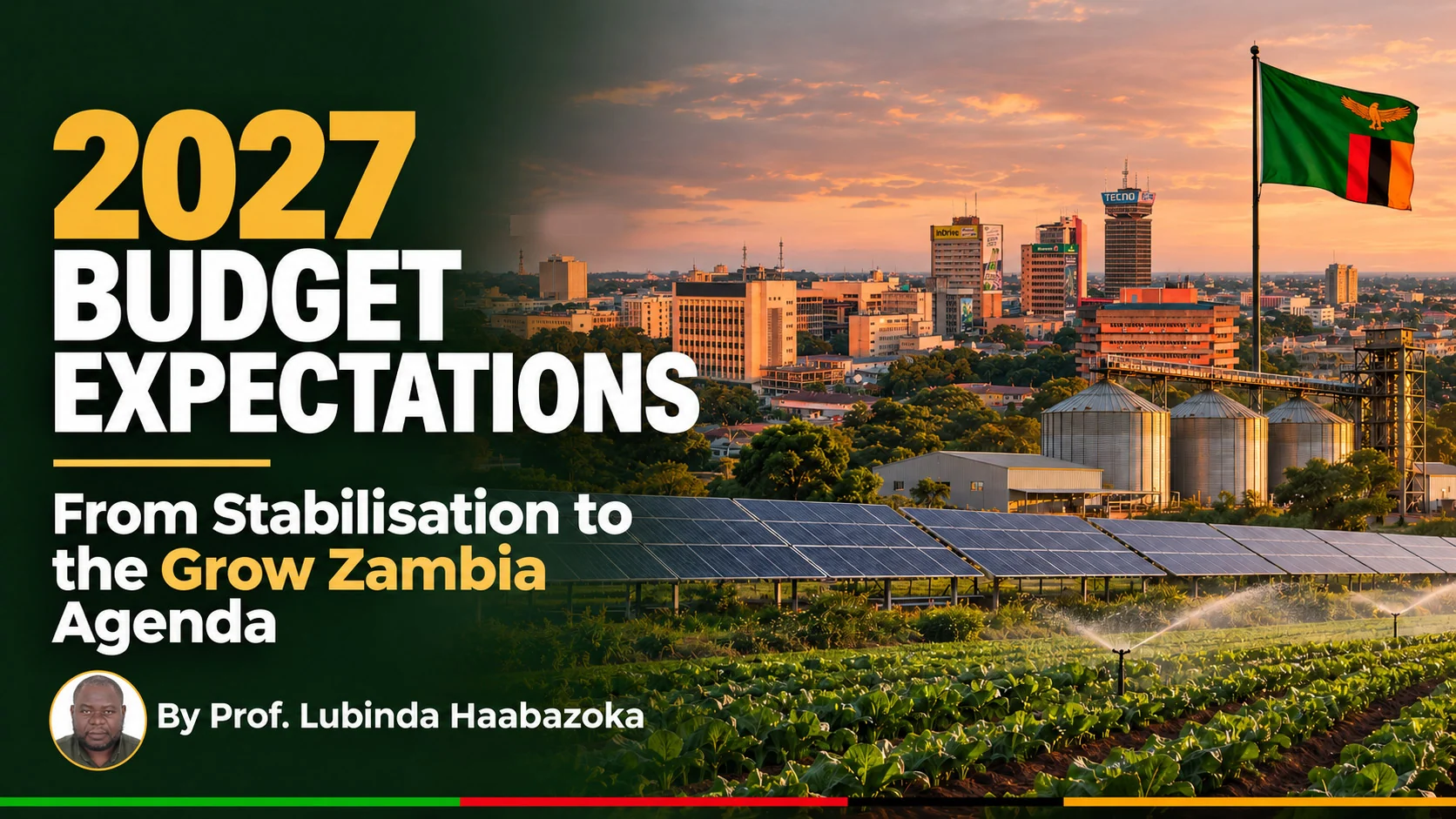
2027 Budget Expectations: From Stabilization to the Grow Zambia Agenda

Breaking News Zambia
NewsBy Prof. Lubinda Haabazoka Government deserves recognition for managing successive budgets through debt restructuring, drought and considerable pressure on public finances, while expanding community funding and social services. The next task is to turn this progress into stronger businesses, increased production, jobs and household incomes. The 2027 Budget must connect economic stabilisation to the Grow
Audio article Listen to this story Share Send this storyBy Prof. Lubinda Haabazoka
Government deserves recognition for managing successive budgets through debt restructuring, drought and considerable pressure on public finances, while expanding community funding and social services.
The next task is to turn this progress into stronger businesses, increased production, jobs and household incomes. The 2027 Budget must connect economic stabilisation to the Grow Zambia Agenda.
WHAT THE 2022-2025 BUDGETS SHOW
The original budget figures reveal improving domestic financing:
• 2022: Expenditure of K173 billion, domestic revenue of K98.9 billion, grants of K1.8 billion and a deficit target of 6.7% of GDP. Domestic revenue covered 57.1% of the budget.
• 2023: Expenditure of K167.3 billion, domestic revenue of K111.6 billion, grants of K1.7 billion and a deficit target of 7.7%. Domestic revenue coverage increased to 66.7%.
• 2024: Expenditure of K177.9 billion, domestic revenue of K141.1 billion, grants of K3.4 billion and a deficit target of 4.8%. Domestic revenue coverage reached 79.3%.
• 2025: Expenditure of K217.1 billion, domestic revenue of K174.2 billion, grants of K8.2 billion and a deficit target of 3.1%. Domestic revenue coverage reached 80.2%.
Across these budgets, planned domestic revenue grew by approximately 76%, against a 25.5% increase in expenditure. These are nominal increases, but the stronger domestic financing position deserves credit.
These figures are original estimates. Expenditure envelopes include principal repayments where applicable, so their financing gaps are not automatically fiscal deficits.
Reported 2025 expenditure was K223.7 billion, with a deficit of 3.4% of GDP, better than the revised 4.6% target, although above the original target. Reported spending included K5.63 billion for CDF, K2.48 billion for Free Education and K9.3 billion for Social Cash Transfer.
PREPARE FOR DROUGHT EARLY
The seasonal outlook points to increased chances of below-normal rainfall in southern Zambia during October–December 2026, extending across much of Zambia during January–March 2027. Anticipated El Niño conditions threaten dry spells in southern and central areas, while northern areas also face flooding risks.
These are forecasts, rather than a certainty of nationwide drought. Nevertheless, the budget must prepare.
Poor rainfall could reduce harvests, rural incomes and tax collections, while increasing food assistance needs and pressure on hydropower. Higher food and electricity costs would affect households and businesses.
The response should include a costed drought contingency, clear emergency funding triggers, protected school feeding and social support, reliable water supplies, timely inputs, drought-tolerant crops, irrigation, water harvesting and livestock disease prevention.
Areas with favourable rainfall should receive support to produce surpluses, with storage and transport connecting them to deficit areas. Solar and diversified electricity supply must support irrigation and business production.
Preparing early costs less than responding after crops fail and reservoirs fall.
FRA: PROTECT FOOD SECURITY AND IMPROVE FINANCING
Building reserves after a good harvest is sensible when drought threatens. However, procurement must have sustainable financing.
The October 2026 supplementary budget proposal of K19.9 billion included K14.7 billion for FRA farmer payments, approximately 74% of the request. Reported purchases reached 2.7 million tonnes, against a 500,000-tonne target: 5.4 times the planned volume.
Government deserves credit for prioritising food security and obligations to farmers. In 2027, purchasing limits, financing and stock management must become clearer.
FRA should disclose procurement volumes, purchase costs, storage, transport, financing charges, losses and expected sales receipts. Reserve targets must reflect consumption needs, usable stocks and drought scenarios.
Private traders, processors and warehouse receipt financing should help absorb commercial surpluses, supported by predictable export arrangements that safeguard domestic requirements.
CDF: TURN EXPANDED FUNDING INTO RESULTS
CDF allocations per constituency increased from K25.7 million in 2022 to K28.3 million in 2023, K30.6 million in 2024 and K36.1 million in 2025. The 2026 allocation of K40 million amounts to K6.24 billion across 156 constituencies.
This expansion is a significant achievement. The next priority is completing projects, improving quality and reducing delays, abandoned works and cost escalation.
Each constituency should publish amounts allocated, released, committed and spent, alongside completed projects. Eligible water, storage and productive infrastructure should strengthen drought resilience. Enterprise beneficiaries also need financial management support and markets.
THE PROPOSED IMF AGREEMENT
On 9 October 2026, Zambia and IMF staff announced a proposed 36-month Extended Credit Facility of approximately US$1.472 billion, subject to Executive Board approval and prior actions.
The framework envisages gradually increasing the primary surplus to 3% of GDP by 2029, beginning in 2027. Priorities include revenue mobilisation, compliance, reviewing exemptions and stronger oversight of FRA, state-owned enterprises, PPPs and arrears.
Government deserves recognition for sustaining this engagement. Implementation should protect productive investment, essential social spending and transparent drought contingencies.
A primary surplus excludes interest. Debt service therefore remains critical: reported 2025 debt payments totalled K58.1 billion, comprising K40.9 billion domestically and K17.2 billion externally, about 26% of expenditure. These include principal where applicable, rather than interest alone.
MAKE BUSINESS EASIER FOR SMEs
Possible 2027 tax measures include inflation-adjusted small-business thresholds, simpler returns, better taxpayer support and a review of turnover taxation for low-margin businesses. Verified VAT refunds need credible payment schedules, while investment incentives should be targeted, time-bound and tied to jobs, production or exports.
These are proposals, and relief must be costed.
Non-tax costs also matter. The original 2025 Budget projected K18.5 billion from user fees, fines and charges, although these were not all business charges.
Reviewing overlapping licences, levies and inspections, publishing fees and introducing clear processing deadlines would ease compliance. Reliable electricity, water and prompt payment of Government invoices would further strengthen SMEs.
WHAT CITIZENS SHOULD WATCH
The budget should present original, revised and actual figures covering:
• Revenue: Taxes, royalties, fees, dividends, grants and tax exemptions.
• Spending: Wages, services, subsidies, transfers, capital investment and interest.
• Financing: Deficits, primary balance, borrowing, principal repayments and refinancing.
• Obligations: Supplier arrears, VAT refunds, pensions and agricultural payments.
• Risks and results: Guarantees, SOE liabilities, PPP commitments, drought contingencies, completed projects and service outcomes.
Government has made encouraging progress under difficult conditions. The 2027 Budget should consolidate these gains through reliable energy, irrigation, processing, transport, tourism, skills and local supplier opportunities.
Its success should be visible in paid farmers, functioning community projects, stronger SMEs, productive jobs and better household incomes, even in a difficult rainfall year.
Your reaction
Have your say
Everyone is welcome. No account or email needed.
Comments 0
Be the first to start the conversation.

Community Feedback