
10,000 Megawatts; Zambia’s gateway to Greener Industrial Future

Breaking News Zambia
NewsBy Samuel Zulu Under the Grow Zambia Agenda, reliable and expanded energy generation has been positioned as the ultimate catalyst for national economic transformation, industrial expansion, and mass job creation. To bridge a critical structural gap exposed by severe climate shocks, the government has set a definitive national benchmark of scaling Zambia’s power generation capacity […]
By Samuel Zulu
Under the Grow Zambia Agenda, reliable and expanded energy generation has been positioned as the ultimate catalyst for national economic transformation, industrial expansion, and mass job creation.
To bridge a critical structural gap exposed by severe climate shocks, the government has set a definitive national benchmark of scaling Zambia’s power generation capacity to 10,000 megawatts by 2031.
Zambia’s current power generation sits at about 4700 megawatts and will need a total of 5,300 megawatts to bridge this gap.
Achieving an ambition of this magnitude, will require far more than routine grid upgrades.
The ambition demands a sweeping structural overhaul of how power is generated, transmitted and financed across the country.
The central question remains: How exactly is Zambia turning this multi gigawatt blueprint into reality?
The drive towards answering that question began during an official media breakfast briefing held on October 15, 2026, at M’kango Golf view in Lusaka, setting the stage for the upcoming second Power and Elec Zambia Exhibition and Conference, slated for October 28 to 30, 2026.
At the media breakfast meeting, representing the Ministry of Energy, Senior Energy Economist Evans Ngalande emphasised that energy security demands immediate and practical diversification.
Mr Ngalande noted that the Ministry of Energy continues to champion an enabling regulatory landscape to fast-track independent power producers, expand solar irrigation, accelerate mini-grids and promote decentralised energy systems.
He stressed that while policy lays the foundation, true implementation requires cutting edge technology, aggressive investment and market driven execution.
Echoing this urgency, Zambia Renewable Energy Association (ZARENA) Chairman Joseph Mutale pointed out that recent climatic challenges and the imminent El Niño make a diversified energy mix and robust transmission infrastructure more critical than ever.
Mr Mutale further said that the conference will help upscale the updated Rural Electrification Master Plan to close energy gaps.
He reiterated ZARENA’s commitment to fueling economic growth in partnership with the Ministry of Energy, through the adoption of renewable energy.
Exhibitions and Trade Services India Private Limited (ETSIPL) representative Vijayanka Brighuvanshi, speaking on behalf of the organisers, reflected on the rapid growth of the platform since its inaugural edition, in November, 2025.
“When we started working on the exhibition, the idea was simple: to create a place where Zambian businesses and international companies could meet, do business and explore opportunities together,” said Mr Brighuvanshi.
Mr Brighuvanshi narrated that the second edition has expanded dramatically in scale and scope, saying it will host over 125 participating companies from Zambia, China, India, South Africa, Saudi Arabia and beyond.
He explained that the comprehensive exhibition ecosystem spans advanced solar panels, Battery Energy Storage Systems (BESS/ESS), heavy electrical infrastructure, transformers, wires and cables, smart grids and the fast-growing e-mobility sector.
“Beyond the exhibition floor, attendees can expect high level panel discussions, technical presentations, targeted training sessions and structured business to business (B2B) buyer-seller meetings running across all three days,” he added.
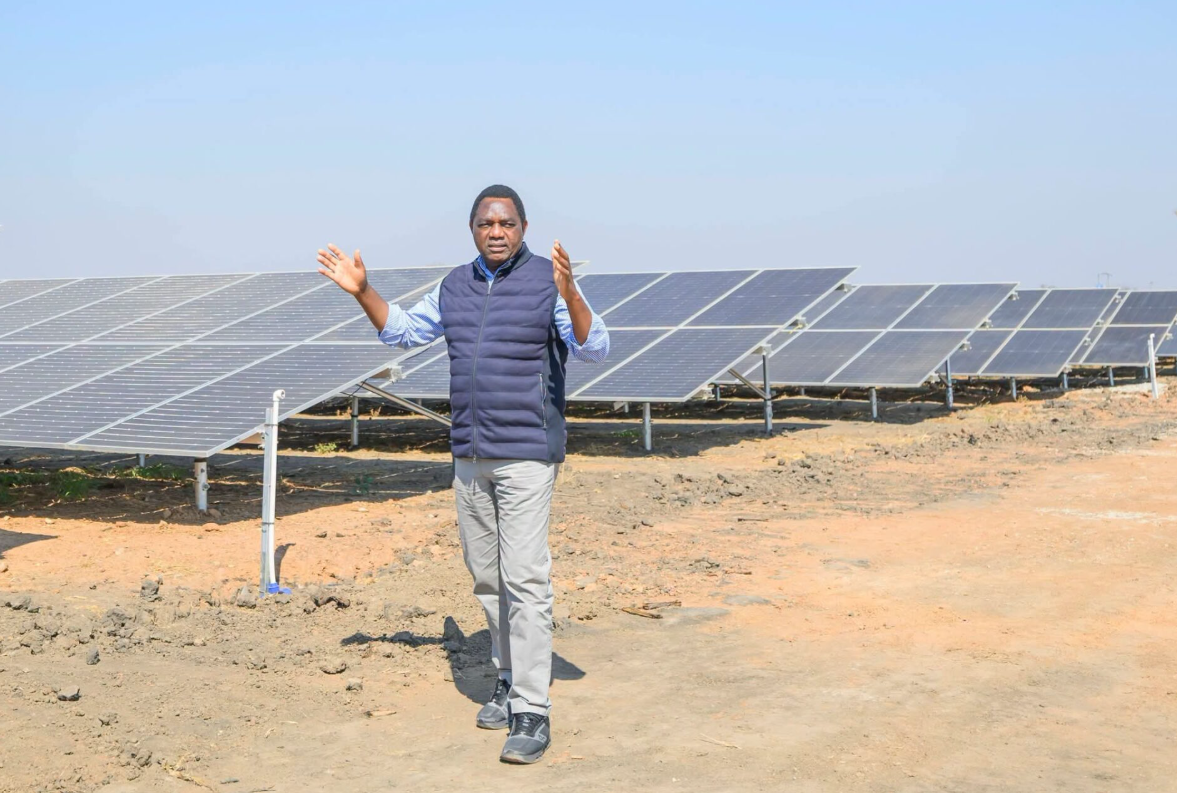
To achieve its target of generating 10,000 megawatts of electricity by 2031, Zambia is looking to diversify its energy mix by investing in renewable sources such as solar, wind and small hydropower, alongside expanding its existing hydroelectric capacity.
These sources are expected to complement conventional power generation, strengthen energy security and provide a more reliable supply of electricity to support industrial growth and economic development.
With solutions ranging from solar-powered agricultural irrigation for local farmers to advanced battery storage for households and small- to medium-sized enterprises, the event directly aligns with the practical implementation needed to achieve national capacity milestones.
The solar powered agricultural irrigation will help farmers not only depend on rain but grow crops like maize even during droughts.
This initiative will not only benefit the farmers but contribute to the grow Zambia agenda of boosting agriculture.
This will result in a push for a large scale agro processing and bring about crop diversification for farmers.
For small scale and medium enterprises, Solar and other renewable energy sources will help reduce electricity costs, maintain reliable operations and increase productivity.
This will ultimately foster business growth leading to the growth of the economy.
This will eventually lead to the Grow Zambia agenda of doubling the size of Zambia’s GDP by 2031 and creation of over 2 million jobs.
Addressing this critical transition, Ministry of Energy Principal Public Relations Officer and Spokesperson Bob Sianjalika noted that the nation is decisively shifting away from traditional sources of electricity.
“All along, Zambia was about 85 percent dependent on hydropower and made it a tradition not to look elsewhere. With challenges like drought and weather changes, the government has resorted to adopting an energy mix,” explained Mr Sianjalika.
Mr Sianjalika emphasised that the Ministry is actively pursuing alternative sources of energy, ranging from solar and thermal to wind power.
He further disclosed that the Ministry had already achieved its 2026 milestone target of 1,000 megawatts as of October, adding that an additional 300 megawatts is scheduled to come on stream by December, 2026.
Behind these ambitious numerical targets, lies a heavy reliance on commercial investment and public-private collaboration.
“Our main comfort in all this drive is the private sector. The private enterprise serves as the primary engine driving this capital-intensive transformation,” stated Mr Sianjalika.
Mr Sianjalika observed that public-private partnerships (PPPs) and aggressive energy diversification, are vital to building a resilient power backbone capable of supporting heavy industries and agricultural irrigation
Mr Sianjalika noted that ZESCO has aggressively positioned itself as a leading investor in utility-scale solar energy generation.
He highlighted that the Grow Zambia Agenda had already attracted significant interest from local and international stakeholders, with the government receiving multiple project applications to advance the multi-gigawatt vision.
With the 10,000 megawatt target firmly in sight, platforms like Power and Elec Zambia, are proving that the nation’s energy revolution is no longer just a blueprint on paper, it is actively being built today.
By bringing together government officials, energy experts, investors and technology providers, the event will help identify practical solutions to the country’s electricity challenges while encouraging partnerships that support sustainable energy development and industrial growth.
Increased adoption of renewable energy, improved transmission infrastructure and greater private sector participation will help reduce dependence on hydropower and improve access to electricity, particularly in rural communities.





Community Feedback